

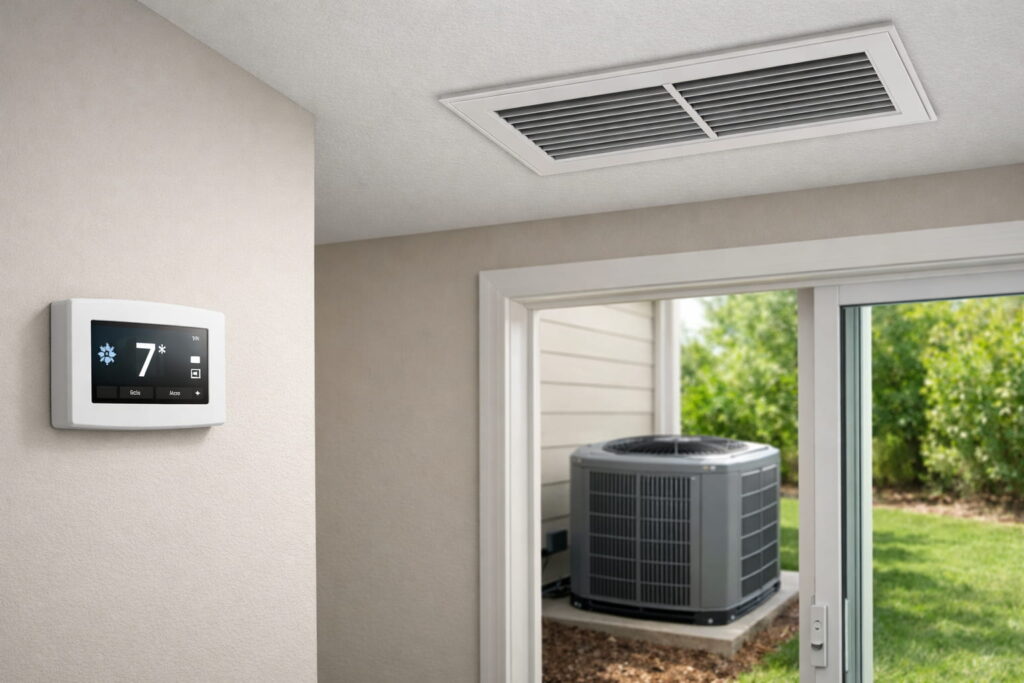
If your ac not blowing cold air but running, start with the thermostat setting, fan mode, air filter, vents, and outdoor-unit airflow before assuming you need a major repair. If those checks do not fix it, the most likely causes are a frozen evaporator coil, low refrigerant from a leak, duct problems, or an electrical fault that needs professional service.
This problem is common: the system sounds like it is working, but the air never gets cold enough to cool the house. The good news is that some causes are simple and safe to check yourself. The key is knowing where homeowner-safe troubleshooting ends and when it is time to call an HVAC pro.
Quick Checks First
- Set the thermostat to Cool and the fan to Auto
- Lower the set temperature below room temperature
- Replace a dirty air filter
- Open blocked supply and return vents
- Clear debris around the outdoor unit
- Turn the system off if you see ice on the coil or refrigerant line
- Do not try to add refrigerant yourself
- Stop and call a pro for repeated breaker trips, burning smells, or recurring freezing
What to Check First
Before you assume the compressor is bad or the system needs refrigerant, start with the fastest safe checks.
First, figure out whether this is a whole-house problem or a one-room problem
Before you start troubleshooting, check whether the issue affects the whole home or just one area.
- If every room feels warm, the problem is more likely the thermostat, filter, frozen coil, outdoor unit, refrigerant level, or another system-wide issue.
- If one room or one zone is warm while the rest of the house cools normally, look more closely at closed vents, blocked returns, duct leaks, dampers, or zone-control issues.
This quick check helps you avoid wasting time on the wrong fix.
1) Check the thermostat settings
A thermostat setting problem can make the system blow air without actually cooling. According to Trane’s AC troubleshooting guidance, the thermostat should be set to Cool, the fan should be set to Auto, and the target temperature should be lower than the current room temperature.
Why this matters: if the fan is set to On, the blower can keep moving air between cooling cycles. That often feels like the AC is running, but the air coming from the vents may feel room temperature.
Also check thermostat batteries if your model uses them.
After making a thermostat change, give the system several minutes to respond. If you replaced a dirty filter or restored airflow, it may take a little longer before the air from the vents starts to feel clearly colder and the room temperature begins to drop.
2) Check the air filter
A clogged filter is one of the most common reasons an AC runs but does not cool well. The U.S. Department of Energy air conditioner maintenance guide explains that dirty filters reduce airflow and system performance, and restricted airflow can contribute to coil icing.
Signs the filter may be the problem:
- weak airflow from multiple vents
- longer run times than usual
- rooms cooling slowly
- visible dust buildup on the filter
If the filter looks dirty, replace it with the correct size and type, then test the system again.
3) Check vents and returns
Cooling performance drops when supply vents or return grilles are blocked. Walk through the house and look for:
- closed supply vents
- furniture or curtains blocking vents
- rugs or boxes blocking return grilles
- one or two hot rooms versus poor cooling everywhere
If the whole house feels warm, the problem is more likely system-wide. If only one area feels warm, airflow balancing or duct issues may be involved.
4) Check the outdoor unit for blocked airflow
The outdoor condenser must be able to release heat. If it is surrounded by debris or overgrown plants, cooling can suffer. The Lennox homeowner troubleshooting page and Trane’s guidance both support checking for blocked airflow, while DOE notes that dirty coils reduce performance.
Look for:
- leaves, grass clippings, or dirt packed around the base
- shrubs or weeds crowding the sides
- obvious debris on the coil exterior
- a top grille blocked by objects
Clear loose debris carefully. Do not remove panels or spray electrical areas.
Common Causes of AC Not Blowing Cold Air But Running
1) Thermostat or fan mode is set wrong
This is the simplest cause and often the easiest fix. If the thermostat is not truly calling for cooling, or the fan is set to On, the system may circulate air without producing the cold airflow you expect.
Safe fix
- Set the thermostat to Cool
- Set fan mode to Auto
- Lower the setpoint a few degrees below room temperature
- Wait several minutes and check whether the vent air feels colder
If the air still is not cooling, move to the next checks.
2) Dirty air filter is restricting airflow
Restricted airflow reduces cooling and can cause the evaporator coil to get too cold and start icing over. The U.S. Department of Energy common air conditioner problems guide points to airflow restriction as a common source of poor performance.
Signs this is likely
- weak airflow at the vents
- AC runs for a long time without cooling much
- indoor comfort gets worse over time
- ice appears on the refrigerant line or near the indoor unit
Safe fix
- turn the system off
- replace the filter
- make sure supply and return vents are open
- restart the system after airflow is restored
If the system freezes again after a clean filter change, stop there and plan for service.
3) Outdoor unit airflow is blocked or the coil is dirty
The outdoor unit cannot cool properly if it cannot move enough air across the condenser coil. Trane says plants should be kept at least two feet away from the sides of the unit. That is a useful rule for readers who have landscaping close to the condenser.
Safe fix
- remove leaves and debris from around the base
- trim back vegetation
- keep the top and sides clear
- gently rinse loose dirt from the exterior coil surface if appropriate for your unit and only from a safe exterior position
Do not bend fins, remove service panels, or attempt deep cleaning inside the cabinet. If the unit still is not cooling after basic cleanup, call an HVAC technician.
4) The evaporator coil is frozen
A frozen evaporator coil is one of the most common reasons an AC runs but stops blowing truly cold air. The Carrier guidance on frozen AC coils says a frozen AC should be turned off rather than left running.
Signs of a frozen coil
- little or no cold air
- weak airflow
- visible ice on the refrigerant line
- water near the indoor unit after thawing begins
Water near the indoor unit can also happen when melting ice overwhelms the drain pan or when the condensate drain is clogged. If you notice active leaking, turn the system off and avoid letting water reach nearby electrical components.
Safe next step
- turn cooling off
- let the system thaw naturally
- check the air filter and vents
- do not chip or scrape ice off the coil
Do not keep the AC running to “push through” the ice, and do not use sharp tools or aggressive heat to speed thawing. That can damage the coil and make the repair more expensive.
If freezing comes back after airflow issues are corrected, the problem may be deeper than a dirty filter.
Stop and call a pro
Call a licensed HVAC pro if:
- the coil freezes again
- the system keeps running without cooling after thawing
- you suspect refrigerant issues
- you cannot safely access the filter or basic airflow checks
Video: Frozen coil / ice on the line
This video helps readers recognize frozen-coil conditions and understand the homeowner-safe first steps before service.
5) Low refrigerant from a leak
Low refrigerant can absolutely cause an AC to run without cooling well, but this is not a DIY top-off job. The DOE says leaks should be repaired and the system charged correctly by a trained technician. The U.S. EPA refrigerant management guidance also makes clear that refrigerant handling is regulated.
Signs low refrigerant may be involved
- cooling gets weaker over time
- the system runs constantly
- the coil freezes repeatedly
- you hear hissing or bubbling near refrigerant lines
Important safety boundary
Do not try to add refrigerant yourself. The U.S. EPA refrigerant safety guidance notes refrigerants can involve important safety hazards, and leak diagnosis plus charging should be handled by qualified professionals.
6) Duct leaks or airflow problems
If the equipment seems to run but the house does not cool evenly, duct issues may be part of the problem. Lennox notes that blocked vents and damaged ducts can reduce cooling performance.
This becomes more likely when:
- some rooms are much warmer than others
- airflow is strong in one area and weak in another
- you suspect attic or crawlspace duct damage
- the system seems to cool poorly even with a clean filter
Safe next step
Check accessible vents and returns first. Beyond that, duct diagnosis usually belongs to a professional.
7) Electrical or control problems
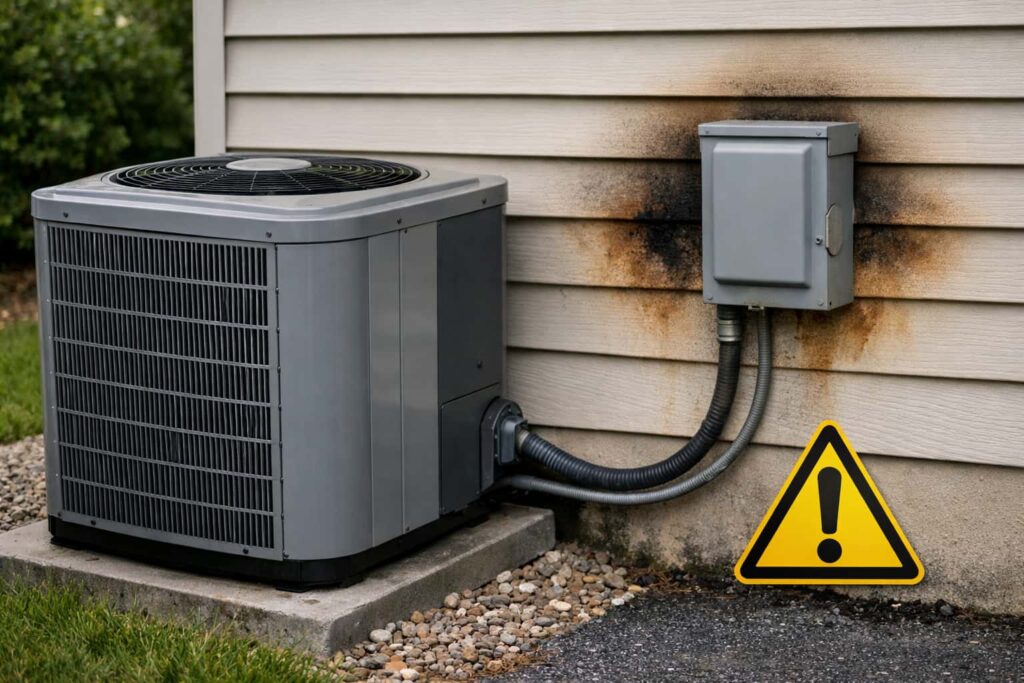
Sometimes the blower runs but the outdoor side is not operating properly. In other cases, the system trips a breaker, cuts out, or behaves inconsistently. DOE says breakers, fuses, and overload protectors can affect operation, but repeated trips point to a bigger issue.
If the indoor blower is running but the outdoor unit is silent, clicking repeatedly, or humming without starting properly, the problem is likely beyond basic homeowner troubleshooting.
Safe homeowner check
- check whether the breaker has tripped
- reset it once if appropriate
- wait a few minutes and test again
Stop and call a pro immediately if:
- the breaker trips again
- you smell burning
- wiring looks damaged
- the outdoor unit hums but does not start properly
- the disconnect or panel area looks scorched or unsafe
Do not open electrical compartments or attempt wiring repairs.
A Quick Homeowner-Safe Troubleshooting Flow
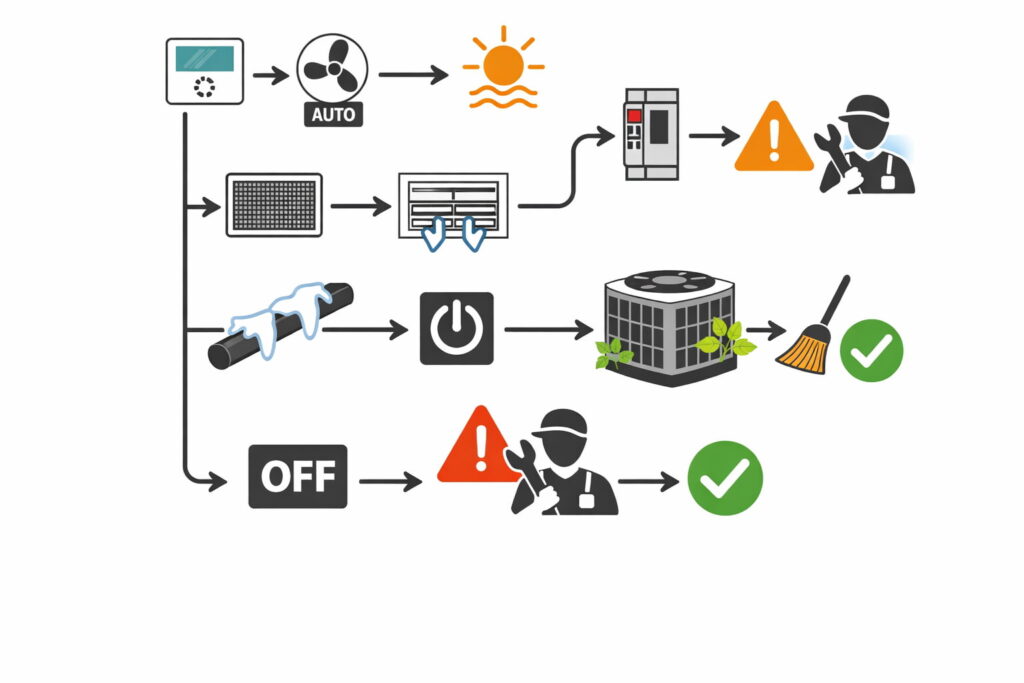
If the AC is running but the air feels warm
Most likely causes:
- thermostat setting problem
- fan set to On
- outdoor unit not rejecting heat well
Safe check:
- confirm Cool
- switch fan to Auto
- lower the target temperature
- clear debris around the outdoor unit
Next step:
- if nothing changes, check the filter and vents
If airflow is weak
Most likely causes:
- dirty filter
- blocked vents
- frozen evaporator coil
Safe check:
- replace the filter
- open vents and returns
- look for ice on lines or near the indoor unit
Next step:
- if you see ice, shut the system off and let it thaw
If the AC runs constantly with little cooling
Most likely causes:
- dirty coil
- low refrigerant
- duct leak
- general system strain
Safe check:
- do the thermostat, filter, vent, and outdoor-clearance checks first
Next step:
- if still not cooling well, schedule service
If you see ice
Most likely causes:
- airflow restriction
- refrigerant problem
Safe check:
- turn the system off
- let it thaw naturally
Next step:
- call a pro if freezing returns
If the breaker trips
Most likely cause:
- electrical or compressor-related fault
Safe check:
- one reset only
Next step:
- if it trips again, stop and call a pro
When to Stop and Call a Pro
Some problems go beyond safe homeowner troubleshooting. Call a licensed HVAC technician if:
- the evaporator coil or refrigerant line keeps freezing
- you suspect low refrigerant or a leak
- the breaker trips more than once
- you smell burning
- the outdoor unit is not working correctly after basic checks
- cooling is poor throughout the house even after changing the filter and checking airflow
- duct damage seems likely
- the system is older and performance has been declining for a while
If you see smoke, damaged wiring, or clear signs of overheating, stop using the system and get help right away.
How to Prevent the Problem From Coming Back
Routine maintenance lowers the odds of your AC running without cooling properly.
Smart prevention steps
- check the filter regularly during cooling season
- keep supply and return vents open
- keep the outdoor unit clear of debris and overgrowth
- pay attention to longer run times or weak airflow
- schedule professional maintenance if performance slips
Helpful YouTube Videos
Thermostat checks first
This video helps readers visually confirm cooling-related thermostat settings before assuming the AC itself has failed.
Dirty filter / weak airflow
This video supports the filter-check section by showing a simple air-filter replacement process that matches the homeowner-safe steps in this guide.
Frozen coil / ice on the line
This video helps readers recognize frozen-coil symptoms and understand the safe first response: shut the system off and fix airflow issues before calling for service.
Outdoor unit airflow / basic condenser cleaning
This video supports the outdoor-unit section by showing basic condenser cleaning and debris removal without crossing into risky repair work.
General AC running but not cooling overview
This video gives a broad visual overview of common reasons an AC can run without cooling properly, which fits the troubleshooting flow in the article.
Frequently Asked Questions
Why is my AC running but not cooling the house?
Common causes include thermostat settings, fan mode set to On, a dirty filter, blocked vents, a frozen coil, low refrigerant, dirty coils, or electrical faults.
Can a dirty filter cause AC not blowing cold air but running?
Yes. A dirty filter can reduce airflow enough to hurt cooling and may contribute to coil icing.
Should I turn my AC off if it is frozen?
Yes. Carrier’s homeowner guidance says a frozen AC should be turned off rather than left running.
Is low refrigerant something I can fix myself?
No. Refrigerant issues should be diagnosed and repaired by a trained technician, not handled as a DIY refill.
Why is my AC blowing air but it is not cold?
That usually means the blower is working, but the cooling side is not. Thermostat settings, dirty filters, airflow restrictions, frozen coils, or refrigerant-related problems are common reasons.
Can blocked vents make my AC seem broken?
Yes. Closed or blocked vents and obstructed returns can make cooling feel much weaker, even when the system is running.
Why is my AC cold at the vent but the house still feels warm?
If the vent air feels somewhat cool but the house temperature barely drops, the issue may be long run times from extreme outdoor heat, a dirty filter, dirty coils, duct leaks, weak airflow, poor insulation, or an aging or undersized system. If basic airflow checks do not help, a professional diagnosis is the next step.
What if my AC breaker keeps tripping?
Stop troubleshooting and call a professional. Repeated breaker trips can signal a more serious electrical or compressor-related problem.
Conclusion
When your ac not blowing cold air but running, begin with the safe basics: thermostat settings, fan mode, filter, vents, and outdoor airflow. Those checks often solve the problem. But if you find ice, suspect refrigerant loss, or see repeated breaker trips, stop there and call a licensed HVAC pro. Catching the problem early can protect both your comfort and your repair budget.
Sources / References
- U.S. Department of Energy — Common Air Conditioner Problems
- U.S. Department of Energy — Air Conditioner Maintenance
- U.S. EPA — Managing Refrigerant in Stationary Refrigeration and Air-Conditioning Equipment
- U.S. EPA — Refrigerant Safety
- Trane — AC Not Blowing Cold Air? Learn What to Do
- Carrier — Will Frozen AC Fix Itself? Guide to Frozen AC Coils
- Lennox — Your AC Isn’t Blowing Cold Air
- Lennox — Outside AC Unit Not Working?