

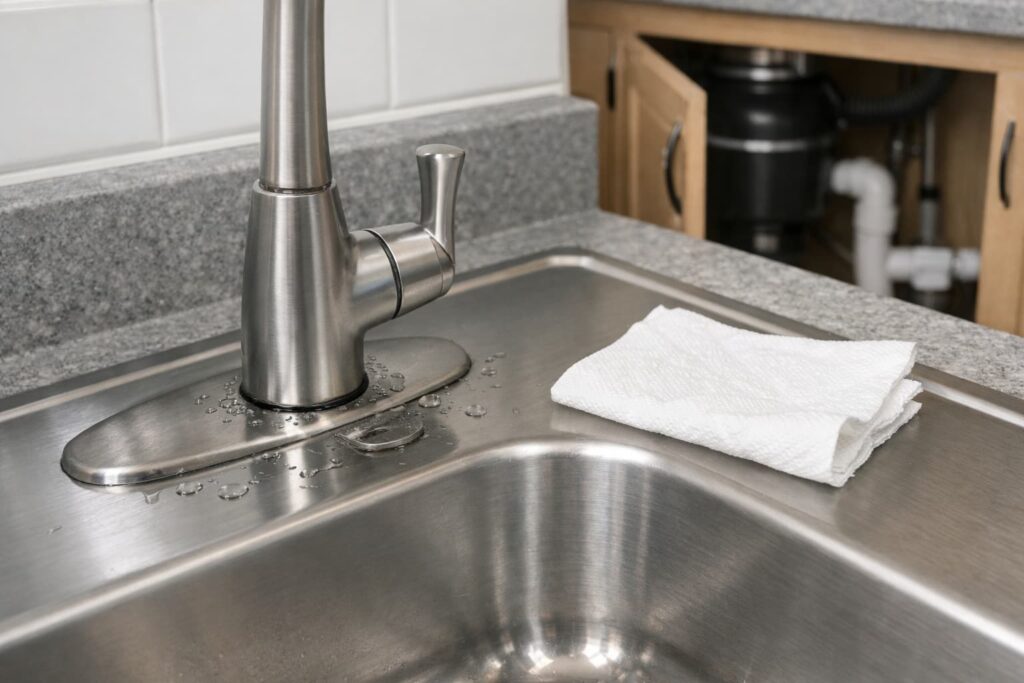
If you have a kitchen faucet leaking at base, the problem is often not the base itself. Water commonly travels down from the handle, the spout seals, the pull-down hose connection, or an under-sink fitting and collects at the base where you can see it. That is why the smartest first step is to trace where the water starts, not where it puddles.
Direct answer: A kitchen faucet leaking at base usually means worn spout seals or O-rings, a handle or cartridge leak running down to the base, a loose pull-down or side-spray connection, or a leak under the sink that only shows up after you use the faucet. The right fix depends on whether it leaks only while running or even when the faucet is off.
Quick Checks First
- If it leaks only while running, suspect spout seals, O-rings, bearings, or hose connections.
- If it leaks after you turn the faucet off, suspect the cartridge or valve-related parts.
- If water seems to appear at the base, first rule out a handle leak.
- If it leaks under the sink all the time, check shutoff valves and supply lines.
- If it leaks under the sink only during use, check the spray hose, pull-down hose, or underbody connections.
- Repair makes sense when the faucet is otherwise solid and you can identify the correct model-specific parts.
- Replace the faucet when the body is cracked, badly corroded, repeatedly leaking, or no longer worth chasing with parts.
What to Do First
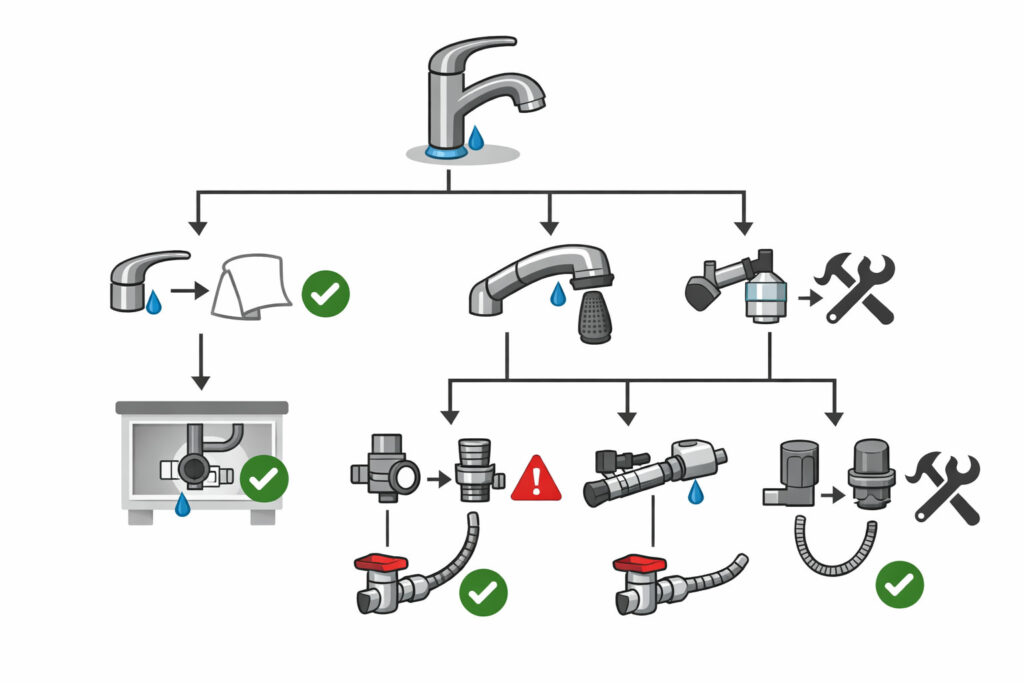
Dry the faucet, countertop, handle area, and the cabinet below. Then run the water for a minute and watch closely.
If water is reaching the cabinet, place a towel or shallow tray under the leak area while you test. This will not fix the problem, but it can help limit cabinet swelling and make it easier to see where fresh drips are starting.
This matters because Moen Solutions notes that a handle leak can puddle on the escutcheon or base plate and make it look like the base is leaking. Moen recommends wrapping a paper towel around the handle and turning the faucet on. If the towel gets wet first, start with the handle or cartridge diagnosis instead of the base.
Quick 2-Minute Diagnosis
- Leaks only when water is running: think spout seals, O-rings, bearings, or a hose connection.
- Leaks after you turn the faucet off: think cartridge, valve, or internal control parts.
- Leaks under the sink all the time: think shutoff valves or supply lines.
- Leaks under the sink only after use: think hose connections, spray hose, or faucet underbody connections.
Moen Solutions and Kohler Assist both support this symptom-first approach.
Common Causes of a Kitchen Faucet Leaking at Base
1) The Handle Is Leaking, Not the Base
This is one of the most common misdiagnoses. Water escapes near the handle, then runs down to the base and forms a puddle.
According to Moen Solutions, a leak from the handle area usually points to the cartridge. Moen also notes that cartridges are model-specific and not interchangeable.
What to check
- Wrap the handle with a dry paper towel.
- Turn the faucet on.
- If the towel gets wet first, treat it as a handle leak.
Likely fix
- Identify the faucet model.
- Replace the correct cartridge or handle-related part for that model.
2) Worn Spout Seals or O-Rings
If the faucet leaks at the base only while it is running, worn or dirty seals are high on the list.
Kohler Assist says a temporary running leak usually means dirt or debris has collected on the seals, O-rings, or bearings, or those parts have worn enough to stop sealing properly. Kohler’s seal-replacement guidance also points to replacing O-rings and bearings and lubricating them with the included silicone-based lubricant.
What to check
- Dry the spout base.
- Run the faucet.
- Watch whether water appears where the spout swivels.
Likely fix
- Replace the correct seal or O-ring kit for your exact faucet model.
3) Pull-Down, Pull-Out, or Side-Spray Hose Connection Leaks
On spray-model faucets, the leak may be at a connection instead of the main faucet body.
Moen Solutions says that on pullout models you should confirm the spray wand and hose connection is tight. Pfister also directs users to check sprayhead-to-hose connections, underbody connections, and the hose itself.
What to check
- Look at the sprayhead joint first.
- Then look under the sink while someone runs the faucet.
- Use a dry paper towel on each visible connection to spot the first wet point.
Likely fix
- Hand-tighten the sprayhead connection if appropriate for your model.
- Replace a leaking hose or connection part if tightening does not solve it.
4) Under-Sink Supply Line or Shutoff Valve Leaks
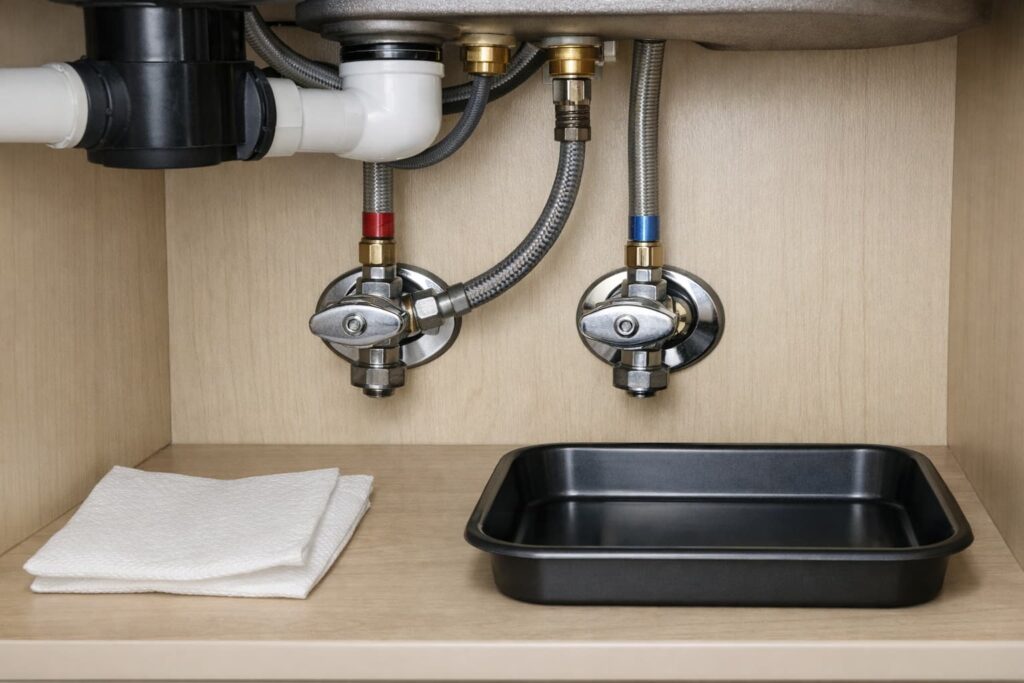
Sometimes the visible puddle near the base is misleading, and the actual leak is below the sink.
Moen Solutions says that if the faucet is leaking under the sink 24 hours a day, you should check the shutoff valves, house supply lines, and faucet supply lines. Pfister also advises checking the exact leak location before assuming the faucet itself is at fault.
What to check
- With the faucet off, inspect both shutoff valves.
- Check the hot and cold supply lines.
- Touch suspect areas with a dry paper towel.
Likely fix
- Tighten an obviously loose accessible connection if appropriate.
- Replace leaking supply components as needed.
Safe Step-by-Step Troubleshooting
Step 1: Confirm Where the Leak Starts
Do not guess based on where water pools. Dry everything first, then run the water and inspect the handle, spout base, sprayhead, and cabinet below.
The goal is to separate a true base leak from a handle leak or hose leak. Moen Solutions provides the handle paper-towel test for exactly this reason.
Step 2: Decide Whether It Leaks Only While Running
This is the fastest way to narrow the repair.
Kohler Assist says a running-only leak points to seals, O-rings, or bearings, while a leak that continues after shutoff points more toward the valve, cartridge, or check-valve/spacer depending on model.
Step 3: Check Hose Connections on Spray Models
If you have a pull-down, pull-out, or side-spray faucet, inspect every visible hose connection before ordering parts.
Pfister says to check the sprayhead connection, then the underbody connections below the sink. If the hose itself is leaking, the hose may need replacement.
Do not keep tightening a fitting that is already snug. If a connection continues to leak after a reasonable check, the problem may be a damaged washer, O-ring, hose, or connector rather than simple looseness.
Step 4: Shut Off Water Before Disassembly
If your diagnosis points to seals or a cartridge, shut off the water supply first.
Kohler Assist begins its seal-replacement procedure by shutting off the supplies before removing the handle and spout. That same guide specifies silicone-based lubricant for replacement O-rings and bearings.
Step 5: Use Exact Model-Matched Parts
This is where many DIY repairs go wrong.
Moen Solutions says cartridges are not interchangeable. Kohler Assist also notes that seal and valve part numbers vary by faucet model number.
Do not buy “close enough” parts.
Before ordering anything, find the faucet model number if you can. It is often on the original paperwork, product packaging, or the manufacturer account or order history. If you cannot confirm the exact model, stop before buying cartridges or seal kits, because the wrong part can look similar but still fail to fit or seal correctly.
Video: Base/Spout Seal Repair
This official Kohler video is useful for the running-leak-at-the-base scenario because it shows the seal and O-ring repair path that matches the spout/base diagnosis in this guide.
Video: Pull-Out Hose Leak Repair
This official Kohler video helps when the leak is tied to the pull-out hose path instead of the faucet base itself.
Video: Cartridge Repair Flow
This official Pfister video is useful when your “base leak” turns out to be a handle or cartridge leak after testing.
When a Simple DIY Fix Is Realistic
A homeowner-safe repair is usually realistic when:
- the leak is clearly coming from an exposed hose connection
- the shutoff valves work properly
- you can identify the faucet model
- the faucet body is intact
- the repair is limited to tightening a connection or replacing accessible seals or a cartridge with manufacturer guidance
This is the type of repair covered by current manufacturer troubleshooting and repair pages from Moen, Kohler, and Pfister.
When to Stop and Call a Plumber
Stop and get professional help if:
- the shutoff valves will not fully close
- the leak is inside the wall, countertop, or cabinet structure
- the faucet body or mounting area is cracked, badly corroded, or loose in the sink
- the leak has caused cabinet swelling, persistent dampness, or mold concerns
- you cannot identify the faucet model and correct parts
- the repair would require more disassembly than basic homeowner access
EPA WaterSense notes that even a faucet dripping once per second can waste more than 3,000 gallons per year, so it is worth fixing a small leak before it turns into a bigger water-waste or cabinet-damage problem.
Repair or Replace?
Repair usually makes sense when the faucet is otherwise solid, the finish is still in good shape, and the leak is clearly tied to a cartridge, seal kit, or hose connection.
Replace the faucet when:
- the body is cracked
- parts are hard to identify
- the faucet has repeated leak issues
- corrosion is severe
- the mounting has loosened or the faucet feels unstable
- the total time and parts cost no longer make sense
Replacement is often the better choice when an older faucet has started leaking from more than one place over time, such as the handle first and the hose or spout later. At that point, another small repair may not save much money or time.
Manufacturer troubleshooting is strongest when the faucet can still be positively identified by model. Once that becomes difficult, replacement is often the more practical path.
Quick Checklist
Try This First
- Dry the faucet and sink deck
- Test the handle with a paper towel
- Check whether the leak happens only while running
- Inspect the sprayhead and hose connections
- Look under the sink with the faucet both off and running
Usually Needs Parts
- Running-only leak at spout base
- Confirmed handle leak
- Leaking spray hose or underbody connection
- Repeated leak after tightening connections
Usually Means Replace or Call a Pro
- Cracked faucet body
- Loose mounting through the sink or countertop
- Leaks inside the cabinet wall
- Shutoff valves do not work
- Repeated failures on an older faucet
FAQs
Why is my kitchen faucet leaking at the base only when I turn it on?
That usually points to worn or dirty seals, O-rings, or bearings around the spout rather than a constant valve problem. Kohler Assist says a temporary leak while the faucet is running is commonly caused by debris or wear at these sealing parts.
Can a handle leak look like a base leak?
Yes. Moen Solutions says water from the handle can puddle on the base plate and look like a base leak. The paper-towel test around the handle is a quick way to confirm it.
Do I need a new cartridge for a kitchen faucet leaking at base?
Sometimes, but not always. If the leak actually starts at the handle or continues after the faucet is off, a cartridge becomes more likely. If it leaks only while running, seals or O-rings may be the real issue instead.
Are faucet cartridges and O-ring kits universal?
No. Moen Solutions says its cartridges are not interchangeable, and Kohler Assist says replacement part numbers vary by faucet model.
What if the leak is under the sink, not on top?
If it leaks under the sink all the time, check shutoff valves and supply lines first. If it only leaks after you use the faucet, check the hose connection cluster and underbody connections. Moen Solutions makes that exact distinction.
Can I still use a kitchen faucet that is leaking at the base?
You may be able to use it briefly if the leak is minor and fully visible, but it is better to limit use until you know exactly where the water is coming from. If water is reaching the cabinet, countertop seam, wall, or shutoff valves, continued use can cause more damage and make the true source harder to identify.
Is it safe to tighten the faucet from underneath?
Tightening an obviously loose accessible connection can be reasonable, but do not force fittings or keep tightening if the leak is coming from the faucet body, an integrated hose, or a damaged shutoff valve. Once the problem goes beyond basic access, a plumber is the safer call.
Conclusion
A kitchen faucet leaking at base is often fixable, but the smart move is to diagnose the leak path before buying parts. Start by figuring out whether the water begins at the handle, the spout seals, the spray hose, or below the sink. Once you know whether it leaks only while running or also when off, the next step becomes much clearer.
If the faucet is damaged, the leak is hidden, or the shutoff valves do not cooperate, stop there and call a plumber. A simple leak is usually manageable. A misdiagnosed leak can waste time, money, and water.
Sources / References
- Moen Solutions — Kitchen Faucet: Leaking Around The Base
- Moen Solutions — Kitchen Faucet: Leaking Around The Handle
- Moen Solutions — Kitchen Faucet: Leaking Under The Sink Base
- Kohler Assist — Leaking at Base of Faucet Spout
- Kohler Assist — Replace Seals on a Single-Control Kitchen Faucet
- Pfister — I Have a Leak (Kitchen)
- U.S. EPA WaterSense — Fix a Leak Week