

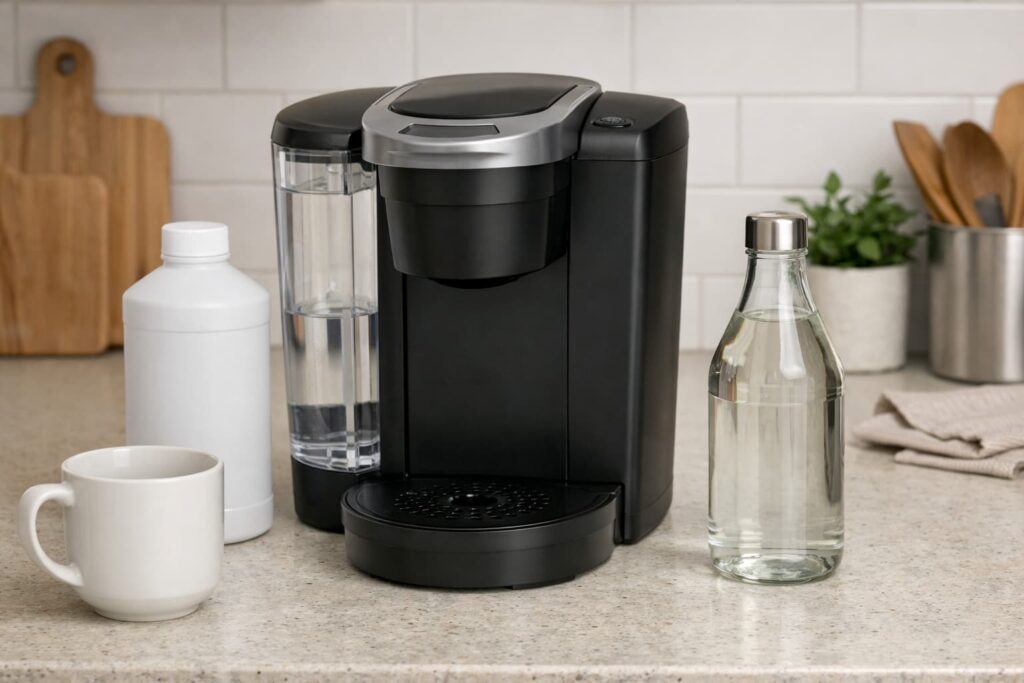
If you are comparing keurig descale solution vs vinegar, the safest answer for most current brewers is simple: Keurig Descaling Solution is usually the better choice because newer Keurig support pages and newer model guides are built around it. Vinegar appears in older official Keurig instructions for some legacy brewers, which is why the advice online still looks split.
Quick Checks First
For most newer Keurig machines, start with Keurig’s current descaling guidance and use Keurig Descaling Solution. If you own an older brewer, check the exact manual, because some older official Keurig instructions did use white vinegar. The safest rule is to follow your model’s current or model-specific guide, not a generic internet tip.
Why the advice is so mixed
The reason this topic gets confusing is that both answers have existed in official Keurig materials. The current How to Descale your Keurig Coffee Maker page gives modern descale-mode instructions for current brewers. Older official Keurig Brewer De-Scaling Instructions explicitly used vinegar for legacy brewers.
That means the right answer is not “vinegar is always wrong” or “vinegar is always best.” The right answer is: use the descaling method your specific brewer guide supports, and treat the newest model-specific Keurig guidance as the priority.
Keurig descale solution vs vinegar: the real comparison
Keurig Descaling Solution
Best for: most newer Keurig brewers, especially models with a descale reminder or descale mode.
Why it is usually the better pick:
- Current Keurig support says descaling is important and gives modern descale-mode steps.
- Newer guides like the K-Supreme Plus Use & Care Guide and K-Express User and Care Guide are written around Keurig’s descaling solution and full rinse cycles.
- Keurig’s Descaling Solution product page positions the solution as routine brewer maintenance.
In plain terms, it wins because it matches the way current Keurig instructions are written.
Vinegar
Best for: older Keurig brewers only when the official manual for that brewer allows it.
Why vinegar still comes up:
- The legacy Keurig Brewer De-Scaling Instructions used about 48 ounces of vinegar for certain older brewers and warned that extra rinse cycles might be needed if taste remained.
- That is why older blog posts and older videos often recommend vinegar with confidence. They are usually echoing older official instructions, not inventing the method.
The limit is that this older vinegar guidance should not be assumed to apply to every newer Keurig.
Which is better for safe Keurig cleaning?
For most readers with a newer Keurig, Keurig Descaling Solution is the safer recommendation. It lines up with current support pages, current descale-mode instructions, and newer model guides. Vinegar may still be acceptable for an older brewer if that brewer’s official manual says so.
A practical rule to follow:
- Newer Keurig model: use Keurig Descaling Solution unless your exact guide says otherwise.
- Older Keurig model: check the manual before using vinegar.
- Unsure which model you have: start with the official Keurig descale support page and then verify your use-and-care guide.
How to identify your brewer before you choose a descaling method
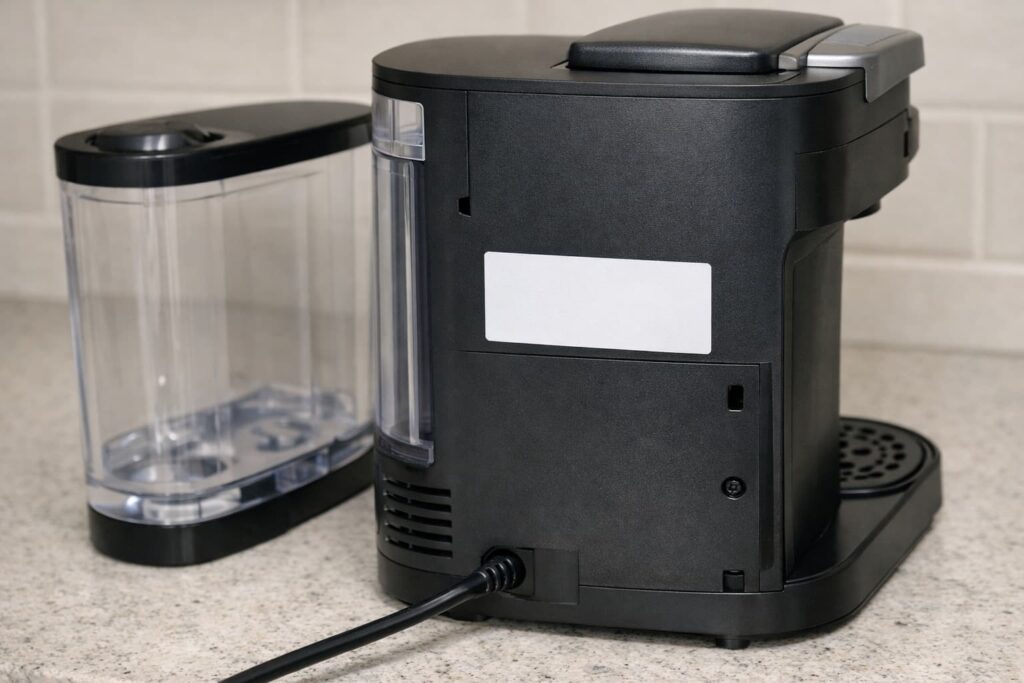
If you are not sure which Keurig model you own, check the label behind or near the water reservoir first. Keurig Support says the serial number for most brewers is found behind the water reservoir, and that is often the fastest way to match your machine to the right support page or use-and-care guide. That one step can keep you from following an older vinegar method that does not match your brewer.
How often should you descale a Keurig?
Keurig’s current support says descaling should generally be done every 3 to 6 months. Some newer model guides are stricter. For example, the K-Supreme Plus guide says to descale every 3 months or when the descale notification turns on. The K-ICED Plus Use & Care Guide says the maintenance alert reminds you to descale after every 250 brews.
If your water is hard, scale can build faster and you may need to descale sooner. The K-Elite Use & Care Guide also notes that water quality affects performance and taste.
A small but useful habit change can help too. Some Keurig guides specifically say not to use distilled water. If your tap water leaves mineral taste or scale quickly, filtered or bottled water may be a better everyday choice for that brewer. Always check your own model’s guide before changing water type.
Before you descale
Before you start:
- Remove any pod.
- Empty the water reservoir.
- Remove the water filter if your model uses one.
- Use a large ceramic mug during the descale process where the guide says to do so.
Do not improvise with random cleaners, and do not mix cleaning products. Stay with the exact method your brewer guide supports.
How to descale a newer Keurig safely
For a newer brewer with descale mode, the general pattern on Keurig’s current support page is:
- Start with the machine plugged in and powered off.
- Enter descale mode using the buttons listed for your model.
- Run the descale process until the reservoir empties.
- Empty, rinse, and refill the reservoir with fresh water.
- Complete the full fresh-water rinse cycle.
Do not stop halfway and assume the descale light will clear. Keurig’s guides repeatedly tie clearing the alert to following the full descaling procedure.
If the descale light does not turn off
In many Keurig guides, the descale light clears only after the full descaling process and full fresh-water rinse are completed. On some models, Keurig also gives a specific button step to exit or reset the descale indicator after descaling. If the light stays on, do not guess. Pull up the exact instructions for your brewer model and follow that model’s descale-light steps rather than repeating random rinse cycles.
Video: current step-by-step Keurig descaling help
Official Keurig video showing the step-by-step modern descaling process, useful for readers who want a visual walkthrough that matches the current support approach.
What if you want to use vinegar?
Vinegar is not automatically wrong. It is just not the safest blanket recommendation for every current Keurig model. If your brewer is older and its official instructions support vinegar, then it may still be acceptable for that specific machine.
The main drawback is practical, not dramatic: vinegar can leave odor or taste behind, and older Keurig instructions explicitly note that you may need extra rinse cycles if residual taste remains.
So if you are deciding between the two and you own a newer brewer, Keurig’s own current materials point you toward the branded descaling solution first.
Quick symptom-to-next-step guide
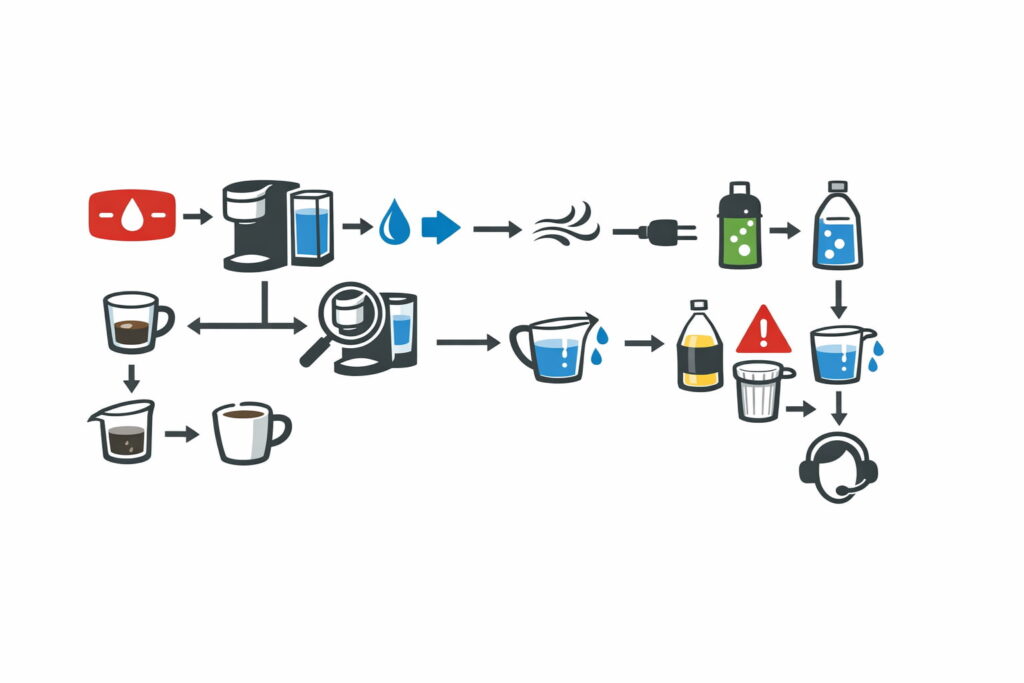
Descale light is on
Likely cause: mineral buildup.
Safe next step: use your model’s official descale process and complete the full rinse cycle.
Brewer is slow or only makes a partial cup
Likely cause: scale, or sometimes a brew-path cleaning issue.
Safe next step: descale first using the approved method for your brewer. If the brewer still makes only a partial cup after repeating the descale process twice, some Keurig guides say to contact customer service.
Little or no liquid comes out during descaling
Likely cause: heavy scale.
Safe next step: newer Keurig guides say this can happen with a heavily scaled brewer. If you hear air-blowing sounds or get little output, unplug the brewer, empty and rinse the reservoir, refill with fresh water, and continue the rinse process. Some guides also say to let the brewer sit unplugged for at least 30 minutes before trying again.
Vinegar smell or taste remains
Likely cause: residue left in the system.
Safe next step: keep running fresh-water rinse cycles until the smell and taste are gone.
Newer models with descale mode
Brewers such as the K-Supreme Plus and K-Express have descale-mode instructions that are more specific than the older vinegar-style “run brew cycles and wait” method. That is a big reason this article’s main recommendation leans toward Keurig Descaling Solution for newer machines.
Video: K-Supreme-style descale walkthrough
A helpful visual walkthrough for K-Supreme owners because it focuses on the modern descale-light workflow and supports the point that newer machines use model-specific procedures.
What not to do
- Do not assume an old vinegar guide applies to a new brewer.
- Do not ignore the descale light for weeks and expect performance to stay normal.
- Do not leave the water filter in if your model guide says to remove it first.
- Do not use a paper cup where the instructions call for a ceramic mug.
- Do not keep repeating home fixes indefinitely if the machine still will not brew correctly after the official descale process.
When to stop and contact Keurig support
Stop and get help if:
- the brewer still only makes partial cups after proper descaling,
- the descale light will not clear after the full procedure,
- the brewer keeps producing little or no output after the rinse-recovery steps,
- you cannot confirm whether your model supports vinegar or expects Keurig Descaling Solution.
Final verdict
Keurig Descaling Solution is the better default choice for safe Keurig cleaning on most current brewers. Vinegar still appears in older official Keurig instructions for some legacy brewers, but it is no longer the best one-size-fits-all recommendation. The safest answer is to match the method to your exact brewer’s official guide.
FAQs
Is vinegar safe for all Keurig machines?
No. Older official Keurig instructions used vinegar for some legacy brewers, but newer Keurig guides for many current brewers are built around descaling solution and model-specific descale steps.
Does Keurig recommend descaling solution or vinegar?
Current Keurig support and newer model guides mainly point users to Keurig Descaling Solution and model-specific descaling procedures. Older official Keurig documents did support vinegar on some brewers.
How often should I descale my Keurig?
Usually every 3 to 6 months, though some models call for descaling every 3 months or after a set number of brews.
Why is my Keurig still brewing a partial cup after descaling?
Scale may still be present, or there may be a brew-path issue. Some Keurig guides say that if repeating the descale procedure twice does not fix partial-cup brewing, you should contact customer service.
Why does my brewer make air sounds during descaling?
Keurig notes that a heavily scaled brewer can produce little output and air-blowing sounds during descaling. The official fix is to switch to the rinse-recovery steps in the guide.
Do I need to remove the water filter before descaling?
Yes, when your model has a water filter and the guide tells you to remove it before descaling.
Conclusion
When comparing keurig descale solution vs vinegar, the best modern recommendation is straightforward: use Keurig Descaling Solution for most newer machines, and use vinegar only when your older brewer’s official Keurig instructions clearly allow it. That approach is more accurate, safer, and much more likely to match the way your brewer was actually designed to be maintained.
Sources / References
Keurig — How to Descale your Keurig Coffee Maker
Keurig — Keurig Descaling Solution
Keurig — K-Supreme Plus Use & Care Guide
Keurig — K-Express User and Care Guide
Keurig — K-ICED Plus Use & Care Guide
Keurig — K-Duo Plus Use & Care Guide
Keurig — K-Elite Use & Care Guide
Keurig — Brewer De-Scaling Instructions
Keurig Support — Locate Your Serial Number