

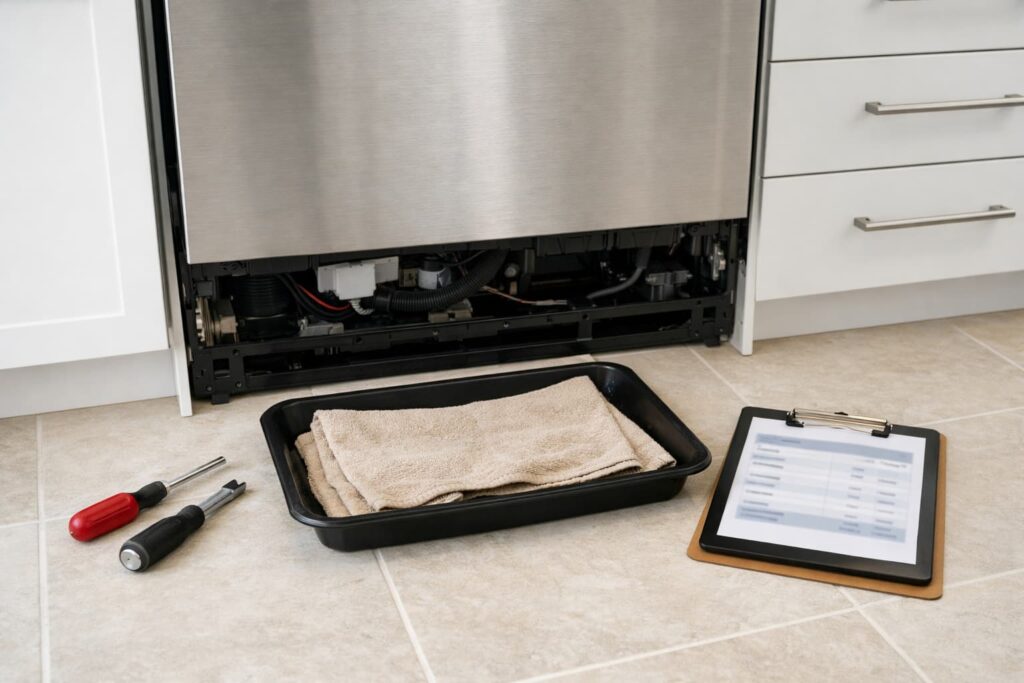
In 2026, the dishwasher drain pump replacement cost is often in the $150–$350 range for the pump repair category, but your total can rise when diagnosis, labor, and “pump-only vs pump assembly” parts are confirmed. Many “won’t drain” problems are actually clogs or hose issues—so a little troubleshooting can save real money.
Quick 2026 cost snapshot (US)
Use these budgeting ranges (then confirm with a diagnosis for your exact model):
- Typical dishwasher repair range: about $175–$325 for many common repairs. Angi — Dishwasher Repair Cost
- Pump replacement (often listed as a category): about $150–$350 (confirm it’s the drain pump). Angi — Dishwasher Repair Cost
- Motor + pump assembly scenario: often around $400–$600 when the repair involves a combined assembly. HomeAdvisor — Dishwasher Repair Cost
What’s usually on the invoice
Even when the part isn’t expensive, the bill may include:
- Diagnostic/service call
- Labor (access + testing + reassembly)
- Parts (drain pump only or a larger assembly)
- Add-ons (clog clearing, hose work, install issues)
What those numbers usually include (so you can compare quotes)
Use this as a quick “sanity check” when you get estimates:
- Diagnostic / service call: often charged even if you don’t approve the repair (ask if it’s credited to the final bill).
- Labor: accessing the pump area, confirming the failure, reinstalling/testing for leaks.
- Parts: either drain pump only or a pump/motor assembly depending on the model.
- Possible add-ons: drain hose replacement, clearing a clog at the sink/disposal connection, or correcting drain hose routing issues.
Drain pump vs wash pump: the #1 reason quotes don’t match
“Pump replacement” can mean different things:
- Drain pump: pushes water out during draining.
- Wash/circulation pump: drives spray during washing.
Some models sell a separate drain pump. Others bundle components into a pump/motor assembly, which can raise parts cost and labor—one reason you’ll see totals closer to the $400–$600 range on some estimates. HomeAdvisor — Dishwasher Repair Cost
When you request a quote, ask: “Is this for the drain pump or the circulation/wash pump—and is it pump-only or an assembly?”
Get accurate pricing fast: find your dishwasher model number first
Before you call for quotes, locate the model number (commonly on the door edge, inner frame, or side of the tub opening). Give it to the service desk and ask them to quote drain pump vs circulation/wash pump by name. This simple step reduces “wrong pump” estimates and helps confirm whether your unit uses a pump-only part or a larger assembly.
What affects dishwasher drain pump replacement cost the most
1) Whether it’s really a pump problem (or a drain-path problem)
A dishwasher that “won’t drain” is often blocked—especially by food debris in filters/pump areas or a kinked/blocked drain hose.
2) Access and labor time
Tight cabinetry, hard-to-move units, corrosion, or prior leaks can add labor.
3) Part type: pump-only vs assembly
If your model uses a combined assembly, costs tend to climb (parts + labor). HomeAdvisor — Dishwasher Repair Cost
4) Service-call/diagnostic fee policies
Ask if the diagnostic fee is credited toward repair.
5) Plug-in vs hardwired electrical
Hardwired units raise complexity and risk; if any wiring work is required, it’s a pro job.
Safety rules before you start (don’t skip)
Dishwashers combine electricity + water, so keep DIY checks limited and safe.
- Disconnect power (unplug if accessible, or turn off the breaker). Some manuals warn that switching “off” doesn’t disconnect power. GE — Dishwasher Manual (PDF)
- Turn off water supply before servicing. Bosch — Dishwasher Instructions (PDF)
- Wear gloves for sharp edges and debris in pump areas. GE Appliance Parts — Drain Pump Spec Page
STOP and call a pro immediately if:
- You smell burning, see smoke, or notice heat damage
- The unit trips the breaker repeatedly
- You see melted wiring or scorching
Dishwashers have had recalls for fire hazards tied to electrical failures—treat these warning signs as non-negotiable. U.S. CPSC — GE Dishwasher Recall Notice
Troubleshoot first (so you don’t buy a pump you don’t need)
Standing water in the bottom after a cycle
Likely causes
- Clogged filter / debris in pump area
- Kinked/blocked drain hose
- Disposal/air gap blockage
- Drain pump failure (possible, but not always first)
Safe checks
- Clean the filter and remove debris (manufacturers commonly point here first). Bosch Owner Support — Dishwasher Not Draining
- Check drain hose routing and the sink connection for kinks/blockage. GE Support — Dishwasher Not Draining
Common setup mistakes that mimic a bad drain pump
- New install + disposal: if a garbage disposal was recently installed or replaced, the dishwasher drain connection may still have the knockout plug in place—water can’t drain properly until it’s removed.
- Air gap (if you have one): a clogged air gap can block draining and cause water backup. If you see intermittent draining or gurgling at the sink, mention “air gap check” when you call for service.
Next step
- If the drain path is clear and it still won’t drain, schedule diagnosis for drain pump vs control/other issues.
Shows how to access/clean a dishwasher filter and unblock the pump area (great visual match for the “debris first” checks).
Official-style filter removal/cleaning demo that supports the “filter-first” troubleshooting step before paying for parts.
Drains slowly or only sometimes
Likely causes
- Partial clog (hose/air gap/disposal connection)
- Debris intermittently blocking the pump area
- Weakening pump
Safe check
- After filter cleaning, inspect common blockage points like drain hose routing and sink/disposal connections. Whirlpool — How to Fix a Clogged Dishwasher
Signs it may not be the drain pump
You may be dealing with a blockage or routing problem (not a pump failure) if:
- Draining improves right after you clean the filter, then slowly gets worse again.
- You notice kinks, sagging, or a questionable route in the drain hose under the sink.
- The sink/disposal backs up at the same time the dishwasher won’t drain.
In these cases, focus on clearing the drain path and correcting hose routing before approving a pump replacement.
Drain hose routing and “high loop” mistakes that look like pump failure
Drain hose routing issues can cause slow draining or backflow symptoms that look like a failing pump. If you suspect a routing problem, follow your brand’s official guidance for loop height/placement. Whirlpool Product Help — Checking the Drain Loop Height
Helpful visual for correct drain hose installation/routing—useful when a “won’t drain” complaint is really an install/loop issue.
If diagnosis confirms the drain pump is bad: what a real quote should include
A good quote should clearly state:
- Drain pump vs wash/circulation pump
- Pump-only vs assembly
- Diagnosis fee policy
- Labor + parts included
- What happens if a clog/hose issue is found during service
After any drain pump repair: do a quick leak check
Once the dishwasher is back in place, run a short cycle and watch for leaks:
- Check under the unit and at the sink connection while it fills and drains.
- Look for slow drips for a few minutes after the drain phase.
- If you see water under cabinets or flooring, stop the cycle and call the technician back—hidden leaks can damage cabinetry and subflooring.
A step-by-step drain pump replacement example that helps readers understand what the job involves after diagnosis confirms the pump.
DIY vs pro: what’s realistic
What many homeowners can safely do
- Clean filters and remove visible debris
- Inspect the drain hose at the sink connection for kinks
- Confirm a recent install didn’t miss a disposal knockout plug
- Keep the area dry and watch for leaks
What’s usually pro territory
- Pulling the dishwasher out when access is tight
- Hardwired electrical work / junction box access
- Internal disassembly beyond basic access panels
- Electrical testing or diagnosing control-board issues
If you’re uninstalling/ reinstalling a dishwasher, follow manufacturer-style safety steps: power off at breaker + water off. Whirlpool — How to Install a Dishwasher
When it makes sense to replace the dishwasher instead
Pump repair is often worth it when:
- The unit is otherwise in good shape
- The diagnosis is clear (drain path is clear; pump confirmed)
- The quote fits your budget range
Replacement may be smarter when:
- The quote approaches the cost of a new unit you’d prefer
- Multiple problems exist (leaks + electrical + poor wash performance)
- The repair requires a pricey assembly plus extra work
FAQs
How do I know if it’s the drain pump or a clog?
Start with filter cleaning and drain hose checks—manufacturers commonly point to debris or routing issues first. If the drain path is clear and it still won’t drain, the drain pump becomes more likely.
Is the dishwasher drain pump replacement cost mostly labor or parts?
It varies by model. Pump-only jobs can be lower, but assemblies and access difficulty can push costs higher.
Why did my estimate jump from $200 to $500?
Often because the repair changed from a simple “pump-only” assumption to a pump/motor assembly or included additional labor for access, diagnosis, or drain-path fixes.
Can I replace a drain pump myself?
Some handy homeowners do, but risks include electrical shock, leaks, and sharp edges. If you can’t safely disconnect power/water and keep the area dry, hire a pro.
What’s the first thing to check if my dishwasher won’t drain?
Check/clean the filters and look for obvious hose kinks at the sink connection before you assume the pump is bad.
What should I do if I smell burning from my dishwasher?
Stop using it immediately and shut off power. Burning smell, smoke, overheating, or breaker trips should be handled by a qualified technician.
Conclusion
Dishwasher drain pump replacement cost in 2026 isn’t one fixed number—it’s a range shaped by diagnosis, labor, and whether your model uses a pump-only part or an assembly. Do the safe “drain path” checks first, then get a quote that clearly names the part and what’s included, so you don’t pay for the wrong repair.
If you’re scheduling service, ask whether the tech will arrive with the correct part based on your model number—that’s the easiest way to avoid repeat visits and extra labor charges.
Sources / References
- Angi — Dishwasher Repair Cost
- HomeAdvisor — Dishwasher Repair Cost
- GE Appliance Parts — Drain Pump Spec Page
- GE — Dishwasher Manual (PDF)
- Bosch — Dishwasher Instructions (PDF)
- Bosch Owner Support — Dishwasher Not Draining
- GE Support — Dishwasher Not Draining
- Whirlpool — How to Fix a Clogged Dishwasher
- Whirlpool Product Help — Checking the Drain Loop Height
- Whirlpool — How to Install a Dishwasher
- U.S. CPSC — GE Dishwasher Recall Notice