

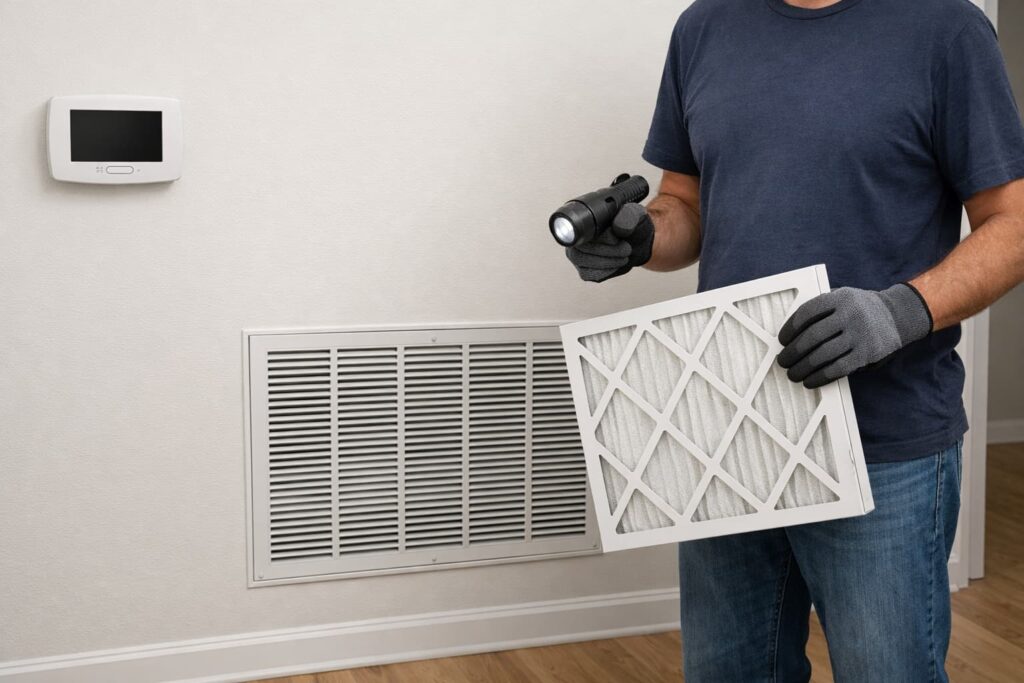
Furnace short cycling causes usually come down to restricted airflow (often a dirty filter), thermostat/control problems, or a furnace that’s oversized for the home—and sometimes a safety shutdown. If your furnace keeps turning on and off too fast, use this safe checklist to narrow down what’s most likely before you call for service.
Short cycling can be annoying, expensive, and hard on your system. In some cases, it’s also a warning sign that the furnace is protecting itself from overheating or another unsafe condition.
Quick symptom splitter (30 seconds)
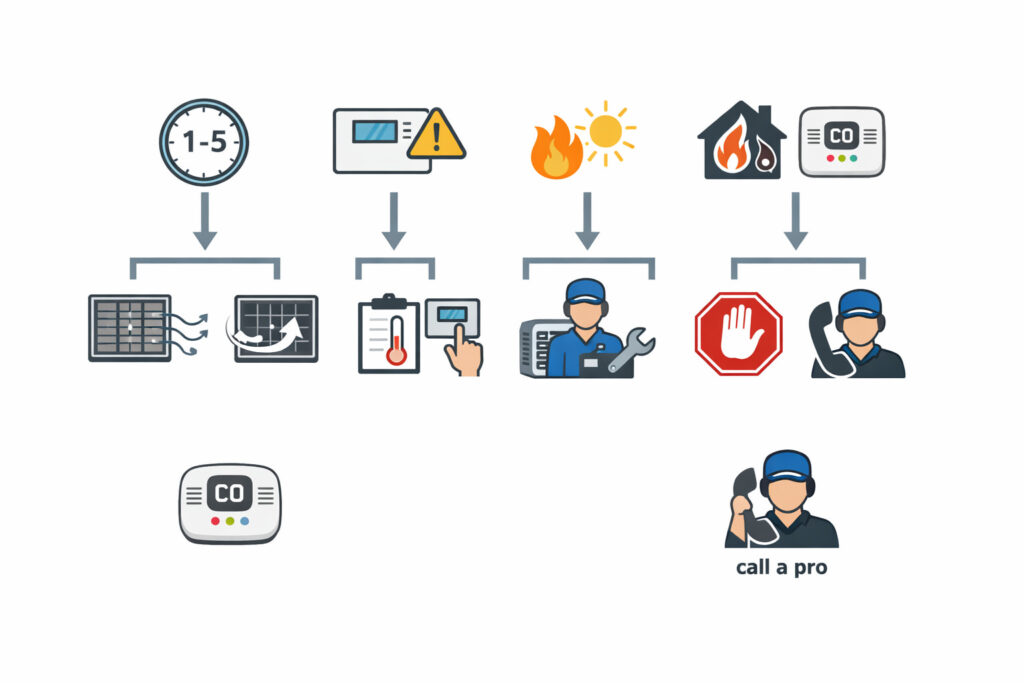
Pick the line that best matches what you’re seeing:
- Runs 1–5 minutes, shuts off, then restarts soon → often airflow restriction/overheating.
- Seems “triggered” by thermostat area (sun, drafts, vent nearby) → thermostat placement or control issue.
- Heats the home fast and shuts off a lot (especially mild weather) → possible oversized furnace or staging/control mismatch.
- Any gas smell, soot, CO alarm, or unusual booming/burning smell → stop and call an HVAC pro now.
If you can, time three cycles with your phone: how long the burners run, whether the blower continues after shutoff, and how soon it restarts. That 60 seconds of notes can save time (and cost) when you call for service.
Safety first: when to stop and call an HVAC pro
Stop troubleshooting and get professional help immediately if any of the following apply:
- You smell gas or suspect a gas leak.
- A carbon monoxide alarm goes off (leave the home and follow your alarm’s instructions).
- You see soot, scorch marks, or melting around the furnace or venting.
- You notice unusual booming, repeated ignition attempts, or a burning smell.
- You see or hear repeated ignition attempts (clicking/trying to light over and over) or the furnace starts then shuts down multiple times in a row.
- The furnace keeps shutting down after you’ve done the basic airflow checks below.
For CO and fuel-burning safety guidance, see the U.S. CPSC Carbon Monoxide Information Center — Home Heating Equipment and the U.S. EPA — Carbon Monoxide’s Impact on Indoor Air Quality.
Quick CO safety reminder—useful for understanding why some “short cycling” situations are a stop-and-call-a-pro issue.
What “short cycling” actually means (and why it happens)
Short cycling is when the furnace starts, runs briefly, shuts off, and then restarts again too soon. A few “short” cycles can happen during mild weather or right after a setback temperature recovery—but frequent, repetitive short cycles usually signal a problem.
Manufacturers commonly point to these main categories:
- Restricted airflow (dirty filter, blocked returns/supplies) → overheating → shutdown
- Thermostat/control problems
- Oversized furnace for the home
- Internal faults or safety-related conditions that require professional diagnosis
(See manufacturer overviews from Lennox — Furnace Short Cycling and Trane — Furnace Short Cycling.)
Furnace short cycling causes checklist (safe homeowner steps)
Work top to bottom. Stop if you hit a safety red flag.
1) Check the air filter (most common cause)
A dirty or restrictive filter can choke airflow. Manufacturers note that reduced airflow can lead to overheating and repeated shutoffs.
Do this (safe):
- Turn the thermostat to OFF.
- If you can safely access the filter, remove and inspect it.
- If it’s visibly dusty, collapsed, damp, or overdue, replace it with the correct size and type.
- Make sure the filter is installed in the correct direction (airflow arrow).
Good habit: ENERGY STAR recommends checking filters monthly during heavy-use months and changing at least every 3 months (minimum guideline). See ENERGY STAR — Heating & Cooling.
Visual walkthrough of a basic HVAC filter change—helpful for the #1 safe first check tied to furnace short cycling causes.
✅ If short cycling improves after a filter change, you likely found a major contributor.
2) Make sure return vents and supply registers aren’t blocked
Even with a clean filter, airflow can be restricted by furniture, rugs, closed registers, or blocked returns.
Do this (safe):
- Walk the home and open supply registers you may have closed.
- Make sure return grilles aren’t covered by furniture, drapes, pet beds, or dust buildup.
- Avoid closing “most” registers to force heat elsewhere—this can increase system stress.
✅ If airflow improves and cycling settles down, airflow restriction was likely part of the cause.
2A) Do a quick power/interrupt check (safe and fast)
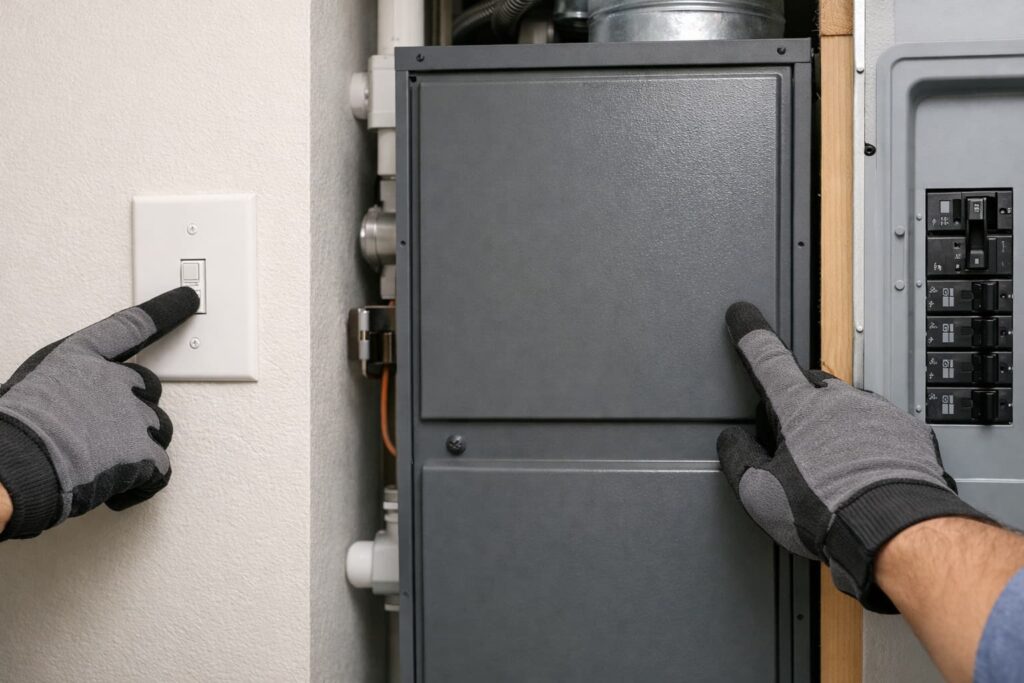
Sometimes “short cycling” is actually the furnace losing power briefly and restarting.
Do this (safe):
- Make sure the furnace access door is fully seated (a loose door can trip the safety door switch on many units).
- Check your breaker panel for a tripped breaker and reset it once if it’s tripped (if it trips again, stop and call a pro).
- If your furnace has a nearby service switch (often looks like a light switch), make sure it’s ON.
Call a pro if: the breaker trips repeatedly, you hear buzzing at the panel, or you smell burning.
3) Look for signs the furnace is overheating and shutting itself down
A common short-cycling pattern is: burners run briefly → shut off → blower may continue → system retries.
Carrier’s homeowner guidance specifically links short cycling to overheating conditions and protective shutoff behavior. See Carrier — Furnace Short Cycling.
If you suspect overheating:
- Re-check the filter and obvious airflow blockages.
- Make sure returns/supplies are open and unobstructed.
- If it continues, call a pro. Persistent overheating can involve blower performance, duct restrictions, or other conditions that require proper testing.
Clear explanation of common furnace short cycling causes (including overheating/airflow patterns) so you know what to report to a technician.
3A) If you have a high-efficiency furnace, check for condensate/venting clues (don’t disassemble)
Many high-efficiency furnaces (often PVC intake/exhaust) can short cycle if a safety switch trips due to condensate drainage issues or vent/intake restrictions.
Do this (safe):
- Look around the furnace base and nearby drain tubing for obvious standing water, wet spots, or a kinked/dripping drain line.
- If you can safely see the PVC pipes, look for obvious damage or a disconnected section (do not re-pipe or reseal anything yourself).
- In freezing weather, note if the termination outside appears blocked by ice/snow (don’t climb or take fall risks).
Call a pro if: you see water around the furnace, suspect a vent/intake blockage, or the furnace keeps restarting.
4) Check thermostat basics (settings and obvious placement issues)
Thermostat and control issues are a top category noted by manufacturers.
Do this (safe):
- Confirm the thermostat is set to HEAT and the setpoint is a few degrees above room temperature.
- If your thermostat uses batteries, replace them.
- Look around the thermostat area:
- Is it in direct sunlight?
- Near a supply vent?
- Near a drafty exterior door/window?
- Near a heat-producing appliance?
What to do next: If you suspect placement is affecting readings, don’t relocate wiring yourself—document what you see and call an HVAC pro to evaluate options.
5) Consider whether the furnace may be oversized
Oversized furnaces can heat the space quickly and shut off frequently—especially in mild weather or in smaller zones of the home. This is listed by manufacturers as a common cause category.
Do this (safe):
- Track a few cycles:
- How long does it run before shutting off?
- How soon does it restart?
- Does it happen more when outdoor temps are mild?
- Note whether certain rooms warm quickly near the thermostat while others lag.
Next step: Oversizing isn’t a quick DIY fix. A pro can evaluate staging, airflow, thermostat configuration, and overall system design.
6) Know which causes are “pro-only” (don’t DIY these)
Some causes listed by manufacturers involve internal safety components or serious conditions—these require professional diagnosis. Other pro-only causes can include ignition/flame-sensing problems (the furnace shuts down because it can’t prove a stable flame) and burner/combustion issues.
Examples include protective controls related to overheating, combustion/venting issues, and suspected heat exchanger problems.
If your furnace repeatedly short cycles after basic airflow and thermostat checks, schedule service and share your observations.
Quick troubleshooting map (printable)
- Replace/check filter → test operation
- Open/clear returns and supplies → test operation
- If still short cycling
- If pattern looks like overheating shutdown → call HVAC
- If thermostat area influences cycling → call HVAC
- If mild-weather frequent cycling and fast heat rise → call HVAC
- Any safety sign (gas/CO/soot/burning smell) → stop immediately
What to tell the HVAC tech (to speed up the fix)
Have these notes ready:
- Approx. run time before shutoff and how often it restarts
- Whether the blower keeps running after the burner shuts off
- Whether replacing the filter changed anything
- Any airflow blockages you corrected (returns/supplies/registers)
- Thermostat location factors (sun/draft/vent nearby)
- Any diagnostic light behavior you can see without removing panels
- Any error code light pattern you can see through the furnace’s sight glass or panel window (don’t remove panels to look).
- The model number (usually on a label inside/near the front panel—only record it if you can see it without disassembly).
FAQs
Why does my furnace turn on and off every few minutes?
Common furnace short cycling causes include restricted airflow (often a dirty filter), thermostat/control issues, or an oversized furnace. If there are any safety signs (gas smell, CO alarm, soot), stop and call a pro.
Can a dirty filter really cause short cycling?
Yes. A dirty or restrictive filter can reduce airflow, which can lead to overheating and protective shutdown behavior. Replacing the filter is one of the safest first checks.
Is short cycling dangerous?
It can be. Sometimes it’s maintenance-related, but it can also be a safety shutdown tied to overheating or combustion/venting conditions. If a CO alarm sounds or you smell gas, stop using the furnace and follow safety guidance.
How do I know if my furnace is oversized?
A common clue is frequent short cycles with quick temperature rise—especially during mild weather. A professional evaluation is the best next step because sizing, staging, and airflow interact.
Should I keep the furnace running if it’s short cycling?
If there are no safety signs, you can do the basic safe checks (filter, vents) and see if it improves. If it continues, schedule service to prevent wear and potential safety issues.
Will closing vents cause short cycling?
It can contribute to airflow restriction. Many systems don’t respond well to having many registers closed because it changes airflow and can increase system stress.
How often should I change my furnace filter?
It depends on the filter type and home conditions, but a common baseline is checking monthly during heavy-use seasons and changing at least every 3 months.
Conclusion
Furnace short cycling causes are often fixable with safe basics: start with the filter and airflow, then check thermostat settings and look for patterns that suggest oversizing or a protective shutdown. If short cycling persists—or you notice any safety red flags—stop and bring in a qualified HVAC professional.