

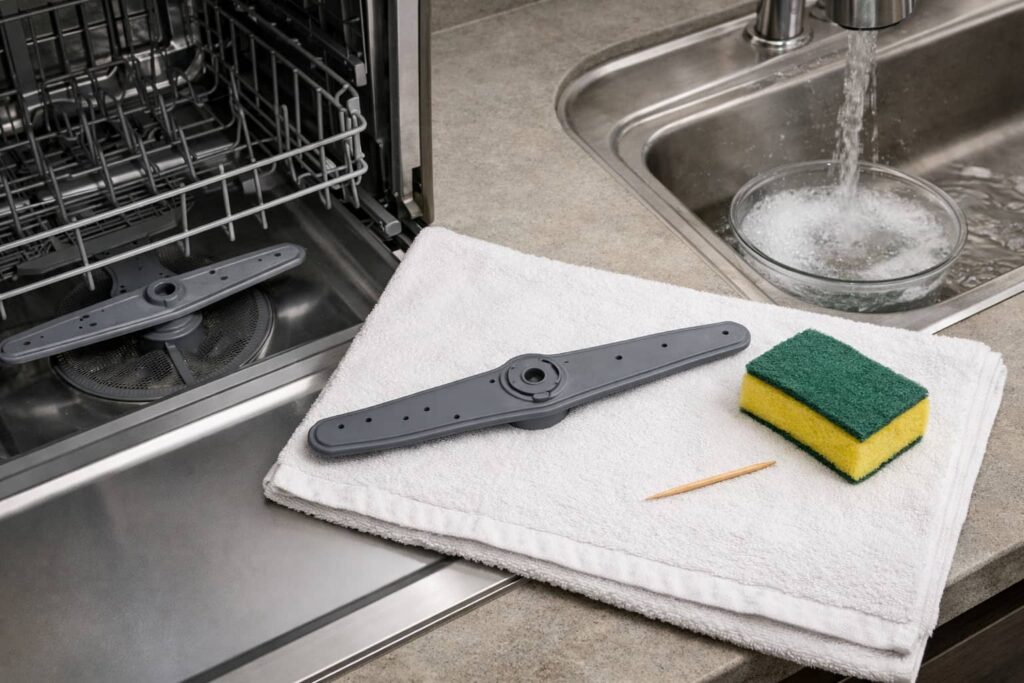
If your dishes come out dirty, cloudy, or gritty, the spray arms are one of the first things to check. To clean dishwasher spray arms, remove them if your model allows, rinse them with warm water, gently clear clogged holes, reinstall them correctly, and make sure they spin freely before the next cycle. According to Bosch’s spray arm cleaning guide, cleaning the spray arms every few months helps maintain wash performance.
Spray arms are what distribute water throughout the dishwasher. When the small holes clog with food debris or mineral buildup, water flow drops and cleaning results suffer. Whirlpool Product Help also notes that loading matters, because poor placement can interfere with spray-arm movement and water circulation.
What you need before you start
Keep the setup simple:
- Warm water
- Dish soap
- A soft cloth or sponge
- A toothpick or similar gentle tool
- A towel for your counter or sink area
If you plan to clean the filter too, Bosch’s dishwasher filter cleaning guide says to wash it under running water with mild soap and a soft brush.
Safety first before you clean
This is usually basic owner maintenance, but do not force parts loose. Spray-arm removal methods can vary by model, especially beyond the lower arm. Whirlpool’s spray arm reattachment guidance says middle spray-arm removal varies by model, so your owner’s manual should guide anything that does not come off easily.
Use only gentle tools to clear the spray holes. Bosch recommends a toothpick, and its guidance focuses on rinsing plus gentle clearing rather than aggressive scraping.
If you are not sure how your spray arm is attached, check your owner’s manual before twisting, lifting, or pulling on it. Lower spray arms are often straightforward to remove, but middle and upper spray arms can use different clips, tabs, or fasteners depending on the model.
How to clean dishwasher spray arms step by step
1) Pull out the lower rack
Start by removing the lower rack so you can reach the bottom spray arm. Bosch’s official instructions begin here.
2) Remove the spray arm if your model allows it
On many dishwashers, the lower spray arm can be removed for cleaning. Some models also allow removal of the middle spray arm. Bosch’s guide removes both the spray arm under the middle rack and the bottom spray arm before cleaning.
If the spray arm does not release easily, stop and check your manual. Do not force it.
3) Rinse the spray arms under warm water
Run warm water through and over the spray arms to flush out loose debris. This is the basic cleaning step Bosch recommends for routine maintenance.
4) Clear the spray holes gently
Look closely at each spray hole. If you see debris or mineral buildup, use a toothpick or similar gentle tool to clear it. Work slowly and avoid enlarging or damaging the holes.
5) Flush out loosened debris from inside the spray arm
After clearing the holes, run warm water through the spray arm again and gently shake it to help flush out any debris trapped inside. This helps prevent loose particles from staying in the arm and clogging the holes again right after reinstallation.
6) Check for mineral buildup
If you see white or chalky residue, hard water may be part of the problem. Poor spray-arm performance is not always just a food-debris issue. Recurring mineral buildup often means the dishwasher needs broader cleaning too, not just one-time spray-arm cleaning.
Before reinstalling the spray arm, wipe the center hub or mounting area to remove any food residue or slime that could interfere with smooth rotation. You do not need to disassemble anything beyond normal cleaning access.
7) Reinstall the spray arms correctly
Reinstall each spray arm the way it came off. Whirlpool says that if a bottom spray arm has come unattached, you align the impeller with the opening and turn clockwise until fastened on applicable models. Since attachment methods vary, follow your model manual if the fit is not obvious.
8) Spin the arm by hand before running a cycle
Before starting the dishwasher, make sure the spray arm turns freely and is not blocked by tall dishes, pans, or utensils. Whirlpool recommends gently spinning the spray arm after loading to test whether the load is blocking movement, and KitchenAid’s loading guidance also says improper loading can obstruct spray arms and reduce cleaning results.
After everything is back in place, run a normal wash cycle and check whether dishes come out cleaner and the spray arms still spin freely afterward.
Clean the filter too, not just the spray arms
If you skip the filter, spray-arm cleaning may not last. Bosch says to remove the lower rack and spray arm, twist and pull out the filter, then wash it under running water with mild soap and a soft brush.
A dirty filter can keep food debris circulating inside the dishwasher, which can lead to repeated clogging and poor wash performance. Cleaning the filter and spray arms together gives you a better chance of fixing the problem in one pass.
Video: Filter + spray arms together
This official Bosch video is helpful because it shows why cleaning the filter and spray arms together makes more sense than treating them as separate jobs.
Why dishwasher spray arms get clogged
The most common causes are:
- Food debris
- Grease residue
- Hard-water mineral buildup
- Poor loading that blocks rotation
- Infrequent filter cleaning
Bosch and Whirlpool both point to clogged holes, poor circulation, and general dishwasher maintenance as common reasons wash results fall off. KitchenAid also stresses that loading can obstruct the spray arms.
What not to do
Do not force a stuck spray arm
If it does not come off with the model’s normal release method, stop and check the manual. Middle and upper spray-arm attachment methods can vary.
Do not ignore loading problems
Even clean spray arms will not help much if large items block them. Overloading and poor placement can reduce water circulation and keep the arms from moving freely.
Do not rely on harsh cleaning methods
Stick to warm water, mild soap where needed, and gentle clearing of the holes. That matches the official Bosch maintenance approach for spray arms and filters.
Quick symptom-to-fix guide
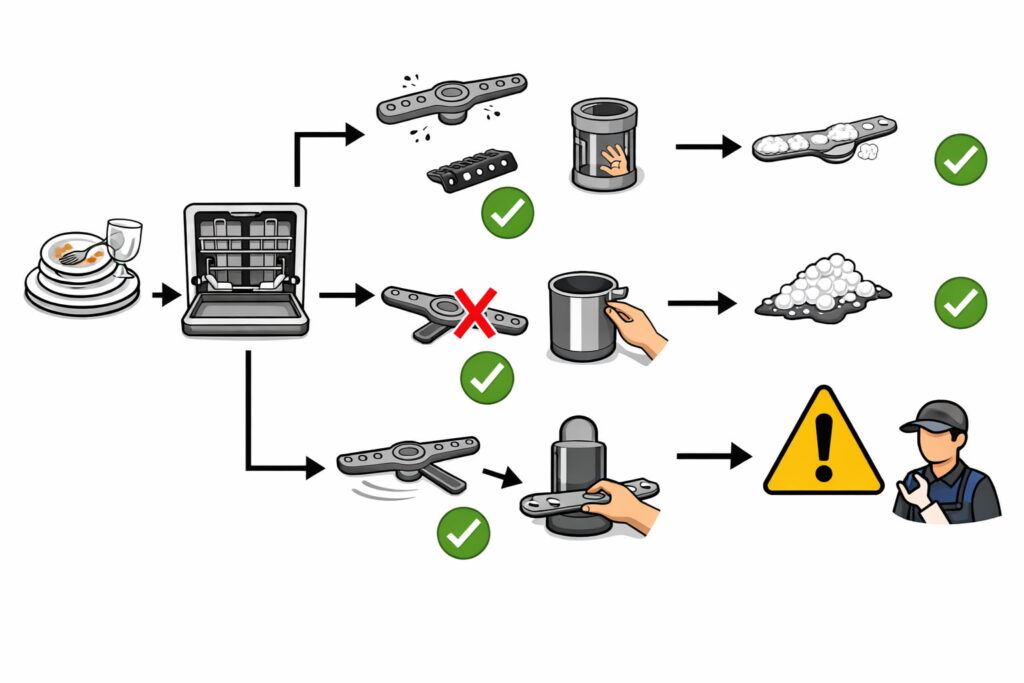
Dishes still come out dirty
Likely cause: clogged spray holes, blocked rotation, dirty filter, or poor loading.
Safe check: inspect the spray holes, spin the arm by hand, and clean the filter.
Next step: rerun a cycle after correcting loading and cleaning both areas.
Spray arm does not spin freely
Likely cause: poor loading or improper reattachment.
Safe check: remove tall or wide items and verify the spray arm is seated correctly.
Next step: if it still does not turn freely, check the manual or service guidance for your model.
White residue keeps returning
Likely cause: mineral buildup or broader dishwasher maintenance issues.
Safe check: inspect the spray holes, filter, and tub for chalky residue.
Next step: clean the machine more broadly and address recurring hard-water buildup if needed.
When to stop and call a pro
Stop DIY troubleshooting and get service if:
- the spray arm still will not spin after cleaning and proper loading
- the spray arm will not stay attached
- the issue seems to go beyond normal owner-access cleaning
- wash performance does not improve even after cleaning the spray arms and filter
If simple cleaning and reattachment do not solve the problem, it is time to move on to model-specific support or service.
How often should you clean dishwasher spray arms?
A good baseline is every few months, especially if you notice dirty dishes, reduced wash performance, or visible buildup. Bosch explicitly recommends cleaning the spray arms every few months.
FAQs
Can I clean dishwasher spray arms without removing them?
Sometimes, yes, for light surface cleaning. But Bosch’s official method removes the spray arms first for a more complete cleaning. If your model allows easy removal, that usually gives better results.
Do I clean the upper and lower dishwasher spray arms the same way?
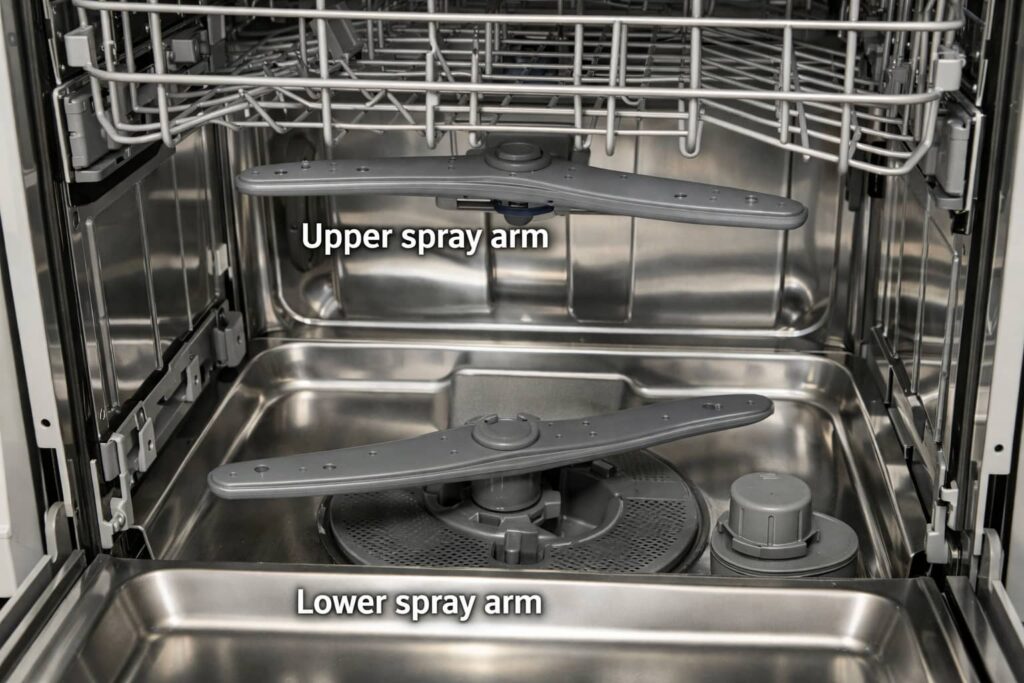
Usually, yes. The basic process is the same: remove the arm if your model allows, rinse it with warm water, clear clogged holes gently, and reinstall it correctly. The main difference is how the arm attaches, especially for middle or upper spray arms, so check your manual if the removal method is not obvious.
What is the best tool to clean dishwasher spray arm holes?
A toothpick is the clearest manufacturer-backed recommendation from Bosch. The goal is to use something gentle that clears debris without damaging the holes.
Should I clean the filter at the same time?
Yes. Bosch’s filter-cleaning instructions pair filter cleaning closely with lower-rack and spray-arm access. If the filter stays dirty, debris can keep recirculating through the dishwasher.
Why are my spray arms clogging so often?
Common causes include food debris, mineral buildup, poor loading, and a dirty filter. If the problem keeps coming back, check the filter and look for white residue that may point to hard-water buildup.
How do I know if dishes are blocking the spray arm?
Load the dishwasher, then gently spin the spray arm by hand before starting the cycle. If anything hits the arm, rearrange the load before running the cycle.
Conclusion
Cleaning dishwasher spray arms is one of the simplest ways to improve wash performance without jumping into repairs. Start with warm water, clear the holes gently, clean the filter too, and confirm the arms spin freely before the next cycle. If the problem keeps coming back, especially after proper cleaning and loading, the next step is model-specific support or service.
Videos
Main spray-arm cleaning walkthrough
This official Bosch video is the best direct match for the main steps in this guide: remove, rinse, clear clogged holes, and reinstall.
Second official visual example
This official Bosch video is a useful backup walkthrough that reinforces the same homeowner-safe spray-arm cleaning process.