

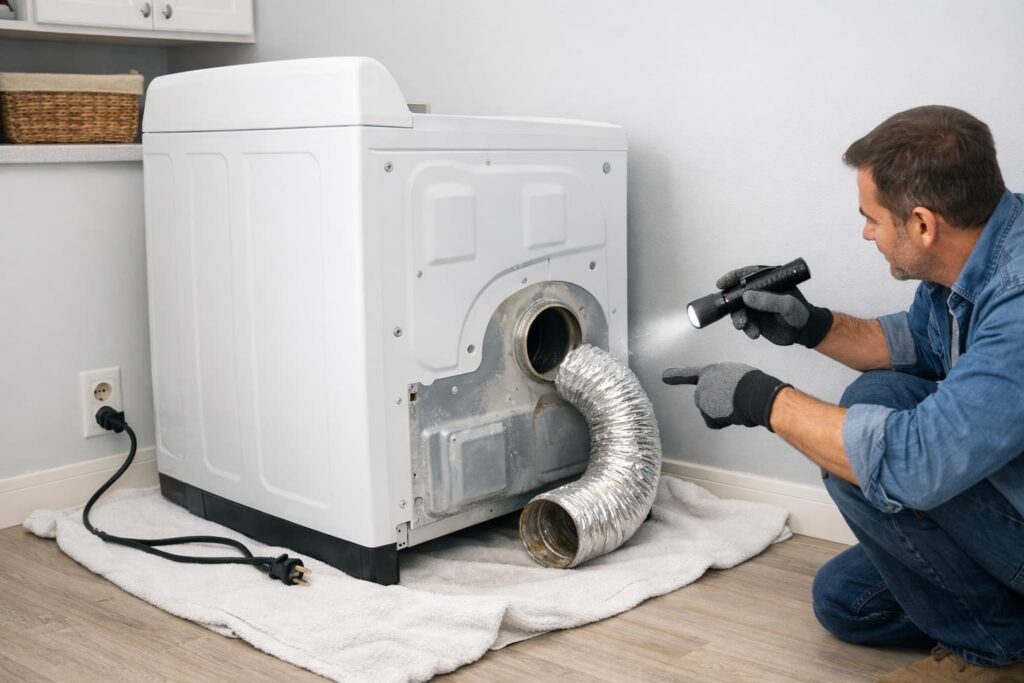
If your dryer takes too long to dry clothes, the most common fix is restoring proper airflow—clean the lint screen, check for a crushed/kinked vent, and make sure the outdoor vent flap opens and isn’t blocked. Once airflow is back to normal, most dryers dry faster, use less energy, and run more safely.
This guide walks you through the safest, highest-impact checks first—without risky disassembly.
Quick diagnosis (2 minutes): what changed?
Before you start troubleshooting, note what’s different:
- Dry times suddenly doubled (problem is usually airflow blockage)
- Loads are larger/heavier (often overloading or mixed fabrics)
- You switched cycles/options (often Eco/low heat settings)
- Clothes feel warm but stay damp (often restricted venting or sensor/setting issues)
- Dryer isn’t getting hot (could be power/heat issue—stop if you smell burning)
Quick check: is your dryer vented or ventless?
Most “long dry time” fixes below assume a vented dryer that exhausts air outdoors through a duct. If you have a ventless/condensing/heat pump dryer, drying can take longer by design, and the biggest “quick wins” are usually cleaning the unit’s lint filters, any secondary filter or condenser/heat-exchanger area your model has, and making sure the dryer has enough clearance for airflow. If you’re not sure, look for a vent duct connected to the back (vented) or check your model label/manual (ventless).
Safety first (do this before any checks)
- Unplug the dryer (electric) before moving it or handling venting.
- For a gas dryer, do not attempt gas-line work.
- Pull the dryer out slowly—avoid stretching or damaging the vent.
Stop and call a pro now if you notice any of these
- Burning smell, smoke, sparking, melted plug/cord
- Repeated breaker trips
- Gas smell (leave the area and contact your gas utility/emergency services)
- Venting that runs through walls/ceilings/roof and you can’t safely access it
- You suspect the vent is disconnected inside a wall (lint odor, moisture, or hot air indoors)
Dryer venting and lint are a known fire risk—basic maintenance matters. See National Fire Protection Association — Clothes Dryer Safety Tips for the safety-focused overview.
Step 1: Fix airflow first (the #1 cause of long dry times)
When a dryer can’t push moist air out, clothes stay damp—even if the dryer feels hot.
A) Clean the lint screen the right way
- Remove lint after every load.
- If you use dryer sheets or fabric softener, the screen can get a waxy film that blocks airflow.
- Wash the screen with warm water and mild dish soap, rinse, and air-dry.
Fast residue test: Run water over the lint screen. If water beads up or runs off in sheets instead of flowing through the mesh, there’s likely residue reducing airflow—wash the screen again with dish soap and a soft brush.
GE calls out lint-screen residue as a common cause of long dry times and recommends washing it when buildup is present in GE Appliances — Dryer Taking Too Long to Dry Clothes.
B) Check the vent hose behind the dryer (easy win)
With the dryer pulled out:
- Look for a kink, crush, or sag in the flexible vent.
- Make sure the connection is secure and not leaking lint.
Even a small crush can dramatically reduce airflow.
C) Check the outside vent hood (often overlooked)
Go outside while the dryer runs (or right after):
- Confirm the flap/damper opens freely
- Remove any lint clumps, leaves, snow, or nests around the hood
- Make sure the hood isn’t stuck closed
Quick airflow check: With the dryer running on a warm cycle, you should feel a strong, steady flow of warm air at the outside hood and see the flap held open. Weak airflow usually means a restriction somewhere in the lint/vent path and is a strong clue to keep focusing on venting before anything else.
D) If dry times are still long, the duct run likely needs cleaning
If your vent run is long, has multiple elbows, or hasn’t been cleaned in a while, lint can build up inside the duct. Many manufacturers emphasize that long/complex runs reduce performance and can trigger “check vent/airflow” warnings.
Whirlpool’s long dry time guidance focuses on airflow restrictions, vent design, and when cleaning is needed in Whirlpool — Dryer is not Drying or Experiencing Long Dry Times.
Safe boundary: If you can’t access the duct run easily (inside walls/attic/roof), hire a vent-cleaning professional.
Call a pro if: the vent run goes up into an attic, across a crawlspace you can’t safely reach, terminates on a roof, or you suspect the duct may be disconnected (lint smell indoors, visible lint behind the dryer repeatedly, or moisture/heat building up inside). Those situations can create a serious lint and fire hazard if handled incorrectly.
Quick visual explanation of what “Check Vent/airflow” warnings mean and what to inspect first when dry times are long.
Walkthrough of cleaning the vent path safely and effectively—helpful if you’re unsure where lint restrictions usually hide.
Step 2: Make sure your cycle and settings aren’t extending dry time
If your dryer takes too long to dry clothes and airflow checks out, settings are next.
Common setting culprits
- Eco / energy-saving options can intentionally reduce heat or extend time.
- Lower temperature cycles may take longer on towels/jeans.
- Sensor cycles can stop early if load size/sensor contact is off.
Samsung notes Eco-type options and vent restrictions can affect performance, and many models include a vent blockage test in Samsung US Support — Clothes are not dry after using Samsung dryer.
Try this quick comparison test (no tools):
- Run the same load on a timed dry cycle (with appropriate heat) and compare results.
- If timed dry is much better than sensor dry, the issue may be sensor-related, load-related, or setting-related.
Step 3: Fix the load (small changes can cut drying time)
Long dry times aren’t always a “broken dryer.” Many are load and sorting issues.
Do this for faster, more consistent drying
- Don’t overload. Clothes need space to tumble and separate.
- Sort by fabric weight. Dry towels with towels, not with light shirts.
- Spin more water out in the washer. Use a higher spin speed if your washer allows it.
- Shake out items before loading (especially sheets).
Step 4: If airflow and settings are fine, check for heat/power issues (safely)
If the dryer runs but doesn’t seem to heat well, do the safe checks below—then stop.
A) Check your breaker/fuse (electric dryers)
Some electric dryers can run (drum turning) even if full heat isn’t available due to an electrical supply issue. (This is included in GE’s long-dry-time troubleshooting guidance.)
Safety boundary: If you suspect wiring issues, outlet damage, or frequent trips, call an electrician.
B) Watch for “airflow” or “check vent” warnings
Many dryers detect restricted airflow and alert you. Whirlpool specifically ties airflow restrictions to long dry times and related warnings in its guidance (linked earlier).
C) Don’t open panels or service gas/heat components yourself
Heating components (and gas systems) can be dangerous. If you’ve restored airflow and are still getting weak heat or very long dry times, it’s time for service.
For a manufacturer overview that starts with airflow/installation as the first root cause of long dry times, see LG Support — Dryer Not Drying or Taking a Long Time.
A simple troubleshooting map (symptom → what to do next)
Dryer takes too long to dry clothes (clothes feel warm but damp)
- Most likely: Restricted venting/airflow
- Do next: Lint screen → vent hose behind dryer → outside hood flap → duct cleaning
Dryer takes too long to dry clothes only on sensor cycles
- Most likely: Eco setting, load size/sorting, sensor contact
- Do next: Turn off Eco option, raise dryness level, test timed dry, reduce load
Shows how to clean moisture sensors so sensor-dry cycles don’t end early and leave clothes damp.
Dryer takes too long to dry clothes and there’s little/no heat
- Most likely: Power/heat system problem (after airflow is confirmed)
- Do next: Breaker check (electric) → stop and book service (especially gas)
Prevention: keep drying times normal (and safer)
- Clean lint screen every load (wash it occasionally if residue builds up).
- Keep the dryer from crushing the vent when you push it back.
- Periodically check the outside hood for lint and confirm the flap opens.
- Use metal venting where recommended and avoid materials manufacturers discourage.
Venting tip: Long dry times often come back when the vent is easy to crush or kink. If your setup uses a flimsy or easily-collapsed connector, consider upgrading to a sturdier, dryer-approved vent connection (or have a technician do it) so airflow stays consistent after you push the dryer back.
Installation/vent routing tips that help prevent repeat airflow restrictions and long dry times.
Demonstrates a vent-connection approach that helps avoid crushing/kinking behind the dryer—one of the most common airflow problems.
FAQs
Why does my dryer take too long to dry clothes all of a sudden?
A sudden change usually points to restricted airflow—a clogged lint path, crushed vent hose, blocked outdoor hood flap, or lint buildup in the duct run.
Can a dirty lint screen really make drying take longer?
Yes. Lint blocks airflow, and residue from dryer sheets can create a film that reduces airflow even when the screen “looks clean.”
My dryer is hot but clothes are still damp—what does that mean?
Often the dryer is heating, but moist air can’t escape due to a vent restriction. Start with the vent hose behind the dryer and the exterior vent hood.
Do Eco settings make drying take longer?
They can. Eco/energy-saving options may reduce heat or extend time to save energy, which can leave clothes slightly damp depending on load type and size.
How do I know if my dryer vent is clogged?
Common signs include longer dry times, hotter-than-usual laundry room, musty odor, lint around connections, or an airflow/check-vent warning (if your model has one).
When should I call a professional for long dry times?
Call a pro if you smell burning or gas, see scorching/smoke, the breaker keeps tripping, venting runs through walls/roof, or you’ve fixed airflow and settings but drying is still unusually slow.
Conclusion
When a dryer takes too long to dry clothes, start with airflow. A clean lint screen, an uncrushed vent hose, and a clear outdoor hood solve a huge share of slow-drying complaints—and improve safety, too. If airflow is clear and the right settings/load still don’t help (or you notice any red-flag symptoms), it’s time to bring in a qualified appliance technician.