

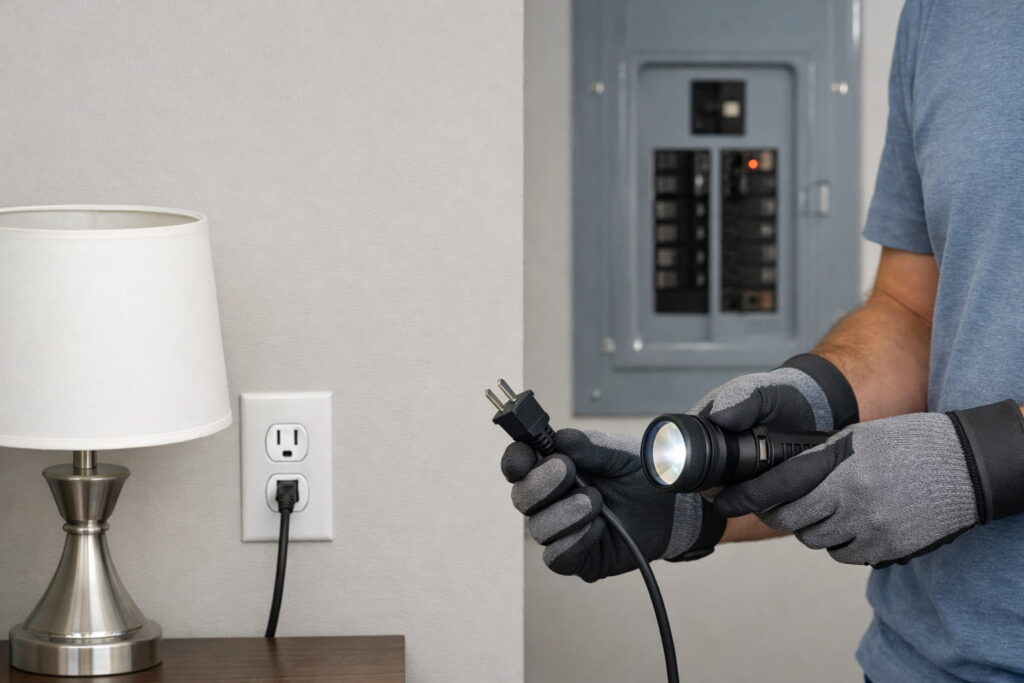
If your outlet not working but breaker not tripped, the most common causes are a tripped GFCI upstream, a breaker that needs a full reset, or a loose/failed connection somewhere on the circuit. Start with the safe checks below—then stop and call a licensed electrician if you see any heat damage, odor, sparking, or repeat tripping.
Before you start: safety first
Electrical problems can turn dangerous fast. Do these basics before any troubleshooting:
- Unplug whatever is in the dead outlet.
- Don’t force plugs into a loose, hot, or damaged receptacle.
- If you notice burning smell, buzzing/crackling, scorch marks, melting, or warmth, stop immediately and call an electrician. The U.S. Consumer Product Safety Commission — Guide to Home Wiring Hazards (PDF) highlights warning signs like overheating and damage that can signal serious risk.
If you want a quick overall scan of electrical safety basics, the Home Electrical Safety Checklist (PDF) is a useful reference for what to look for around outlets, cords, and panels.
Quick diagnosis: what’s dead?
Use this 30–60 second triage to pick the right path.
Only one outlet is dead
Most likely:
- A tripped GFCI feeding it
- A switched outlet you forgot about
- That outlet itself failed
- A loose connection at another outlet on the same circuit
Several outlets in one area are dead
Most likely:
- A tripped GFCI feeding multiple outlets
- A breaker that looks ON but needs a full reset
- A wiring fault (call a pro if there are any warning signs)
A helpful clue: what else stopped working?
Walk the nearby rooms and check a few common “shared circuit” items (without opening anything): lights, bathroom outlets, garage outlets, outdoor outlets, and hallway receptacles. If multiple things are out, you’re likely dealing with one circuit and the fix is usually one upstream GFCI or one breaker reset—not the dead outlet itself.
The outlet died suddenly and you notice heat/odor/sparks
Stop. That’s not a DIY troubleshooting situation.
Step 1: Do the fastest “is it really the outlet?” checks
These prevent chasing the wrong problem.
- Plug your device into a different outlet you know works.
- Plug a simple lamp (or phone charger) into the “dead” outlet.
- If you have a power strip, bypass it—plug directly into the wall.
If the outlet is still dead, move on.
Step 2: Find and reset a tripped GFCI (most common cause)
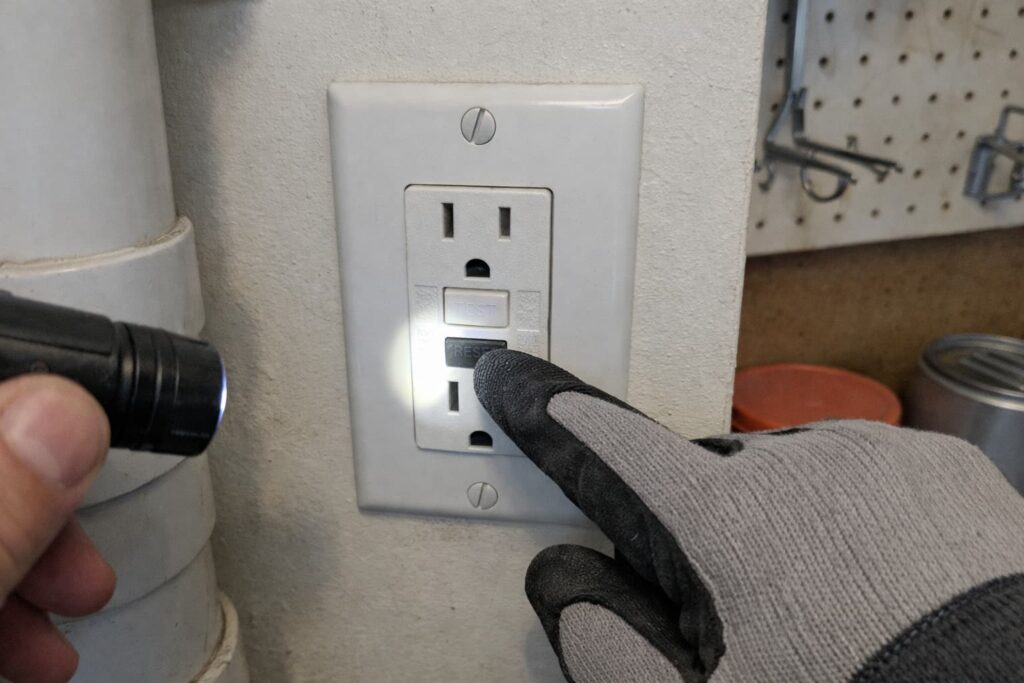
A key reason an outlet can be dead while the breaker isn’t tripped: another GFCI device upstream tripped and shut off power—even if the dead outlet is not a GFCI.
Where to look for the “upstream” GFCI
Check every place a GFCI commonly lives, even if it feels unrelated:
- Bathrooms (including half baths)
- Kitchen counters
- Garage
- Basement / crawlspace
- Laundry / utility room
- Outdoor outlets
- Anywhere near sinks, wet bars, or unfinished areas
GFCIs are common in these types of locations; NFPA’s guidance is a helpful reminder of how prevalent they are in homes: NFPA — 5 Ways to Check Ground Fault Circuit Interrupters.
Quick tip to find the right GFCI faster:
- Check every bathroom, garage, basement, and outdoor GFCI—even if the dead outlet is in a bedroom or living room.
- Look for “hidden” GFCIs in utility rooms, unfinished basements, garage side walls, behind stored items, and near sump pumps or laundry areas.
- After you reset one, immediately re-check the dead outlet—sometimes you’ll find the right GFCI on the first or second try.
How to reset a GFCI receptacle correctly
On the GFCI outlet, press:
- TEST (you may hear a click and power should shut off)
- RESET (power should return)
Follow the manufacturer’s instructions for the TEST/RESET process and indicators: Leviton — Installing and Testing a GFCI Receptacle (PDF).
This Leviton video quickly shows what to do when a GFCI “isn’t working” and how to try TEST/RESET safely.
This Leviton video demonstrates the basic TEST/RESET process so you can confirm a trip and restore power.
If the GFCI won’t reset:
- Don’t keep forcing it.
- Treat it as a fault condition and move to the “Stop and call a pro” section below (or replacement by a qualified person).
Step 3: Reset the breaker the right way (even if it looks ON)
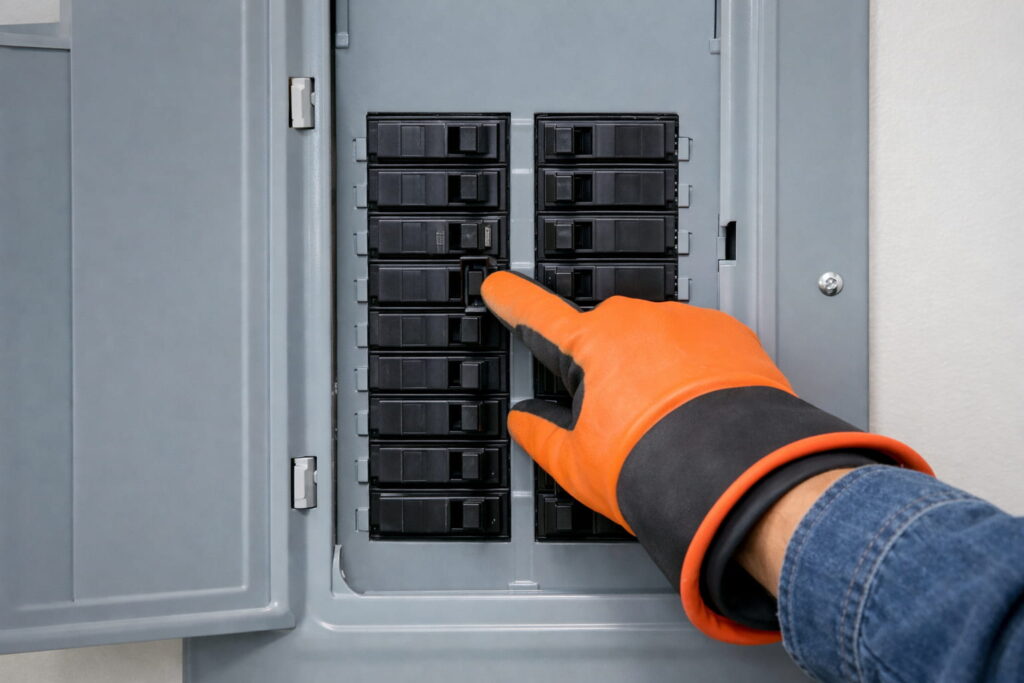
Some breakers can look “not tripped” but still need a full reset.
- Go to your electrical panel.
- Identify the likely circuit (outlets in that room/area).
- Flip the suspected breaker firmly to OFF, then back to ON.
Note: Some homes use AFCI or dual-function (AFCI/GFCI) breakers for outlet circuits. These can trip for safety reasons even when the handle doesn’t look fully “off.” A full OFF → ON reset is still the correct first step. If it trips again, that’s your cue to stop and call a licensed electrician.
If you have a GFCI breaker (test button)
Some panels use GFCI breakers and they may include a TEST button. Reset behavior can vary by model, but the handle positions (ON/OFF/TRIPPED) matter. For a general explanation of breaker handle positions and what “tripped” can look like, see: Schneider Electric — GFCI breaker test button FAQ.
This Schneider Electric Support video explains breaker handle positions (including the tripped position) so you can reset correctly.
If the breaker trips again or won’t stay on: stop and call a licensed electrician.
Step 4: Check for a switched outlet (the “it was working yesterday” culprit)
In many homes, one outlet in a room is controlled by a wall switch (for a lamp).
What to look for: If an outlet has two plug-in spots, it’s possible one works and the other doesn’t when the wall switch is off. Test both the top and bottom receptacles before assuming the whole outlet is dead.
Try:
- Every wall switch in the room (including the one that “does nothing”)
- Nearby rooms if they share a wall
- A second outlet on the same wall
Tip: If the top plug works but the bottom plug doesn’t (or vice versa), you may have a “half-switched” setup. That’s normal in some homes, but it can also mask other issues—so don’t assume.
Step 5: Know when this is not a DIY fix
If you’ve done the safe checks above and the outlet is still dead, the likely causes shift toward:
- A failed receptacle
- A loose connection at another device on the circuit
- An “open neutral” or other wiring fault
These can be dangerous if there’s heat damage or arcing risk. Use the stop conditions below.
Stop and call a licensed electrician if any of these are true
This is the non-negotiable safety line:
- Burning smell, smoke, sparking, buzzing/crackling
- Scorch marks, discoloration, melted plastic, or the outlet/plug feels hot
- The outlet feels loose (plug won’t stay snug) or the plug blades look darkened
- You’ve noticed intermittent power (works sometimes, then cuts out) when the cord is bumped
- Breaker re-trips, won’t reset, or you’re not sure which breaker controls the circuit
- You see signs of water/moisture near the outlet, panel, or wiring
- The outlet is in a kitchen/bath/garage/outdoors and a GFCI won’t reset
- You’re tempted to remove covers, pull outlets out of the wall, or do live testing
When in doubt, treat it as a hazard—especially if the outlet failed suddenly after heavy use (space heater, hair dryer, vacuum, etc.).
Prevention: reduce repeat trips and dead-outlet surprises
A few habits help keep this from happening again:
- Test GFCIs periodically using TEST/RESET (manufacturer instructions matter for your exact device).
- Keep outdoor covers intact and replace cracked covers (moisture is a common trigger).
- Avoid overloading a single receptacle with high-draw appliances.
- If an outlet feels loose, worn, or warm, don’t ignore it—get it checked.
FAQs
Why is my outlet not working but breaker not tripped?
Most often, a GFCI upstream is tripped, the breaker needs a full OFF → ON reset, or there’s a loose/failed connection somewhere on the circuit.
Can one GFCI shut off other outlets?
Yes. A single GFCI receptacle (or GFCI breaker) can protect and shut off power to multiple downstream outlets—even if those outlets don’t have TEST/RESET buttons.
What if the GFCI won’t reset?
Don’t keep forcing it. A GFCI that won’t reset can indicate a device fault or a downstream problem. Stop troubleshooting and contact a licensed electrician if you can’t restore power safely.
My breaker looks ON—do I still need to reset it?
Yes. Some breakers need to be moved fully to OFF before they can reset properly. If it trips again, call an electrician.
Could a wall switch control the dead outlet?
Yes. Many living rooms and bedrooms have a switched outlet for lamps. Try all wall switches in the room and nearby.
Is a dead outlet dangerous?
It can be. If you notice heat, odor, discoloration, sparking, or sounds, stop immediately—those are red flags for an unsafe condition.
Should I replace the outlet myself?
If you’re not experienced and fully confident working with electricity, it’s safer to hire a licensed electrician—especially if the outlet is warm, damaged, or the cause isn’t obvious after the safe checks.
Conclusion
When an outlet not working but breaker not tripped, start with the safe wins: verify the device, reset any upstream GFCIs, then reset the breaker correctly and check for a switched outlet. If anything looks or smells wrong—or if power won’t restore after these checks—stop and bring in a licensed electrician.