

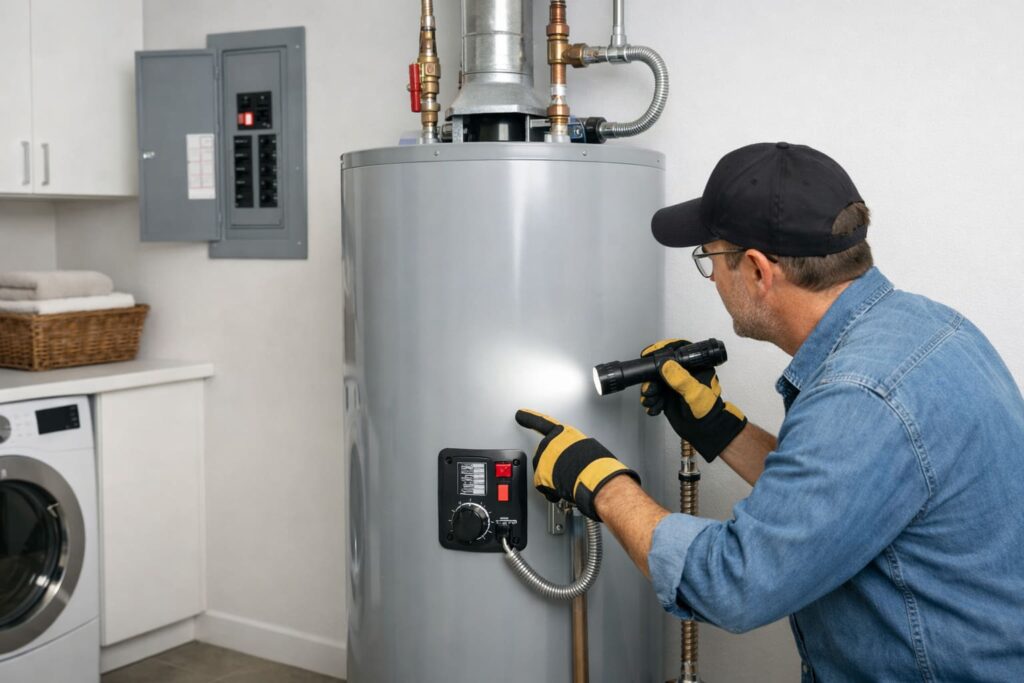
If your water heater not producing hot water has you stuck with cold showers, start with a few safe, high-payoff checks before assuming the unit is “done.” In many cases, the fix is a tripped breaker/high-limit reset, a gas ignition shutdown, or a tankless flow/lockout issue—not a full replacement.
This guide covers electric tank, gas tank, and tankless systems with clear DIY-safe steps and firm stop/call-a-pro boundaries.
Safety First
Stop immediately and get help if any of these are true
- You smell gas or suspect a gas leak: leave the area, avoid switches/flames, and follow CT.gov — What To Do If You Smell Natural Gas.
- You see scorching, melted insulation/wiring, or smell burning.
- The heater was exposed to flooding, fire, or physical damage—don’t operate it until inspected by qualified service. Rheem — Residential Electric Use & Care Manual (AP23124-1).
- The fix would require live electrical testing, gas valve work, vent modifications, or internal combustion work.
Basic safety rules
- Electric tank: turn power OFF at the breaker before removing access panels.
- Gas tank/tankless: don’t disassemble sealed gas controls or adjust gas pressure (pro-only).
- Put insulation and covers back exactly as found before restoring power.
Quick Diagnosis: Which “No Hot Water” Situation Are You In?
- No hot water anywhere (whole house) → heater/supply issue likely
- Lukewarm or runs out fast → temperature/capacity/recovery/sediment or partial failure
- Only one fixture is cold → often a fixture cartridge/mixing valve issue
- Tankless: no hot water (with or without error code) → lockout/flow/maintenance/service issue
Before you troubleshoot: confirm what you have. Look for the rating plate/label on the tank (or inside the tankless front cover area) and note the fuel type (electric/gas) and whether it’s a tank vs tankless. If you’re unsure:
- Electric tank usually has two access panels on the side and no vent pipe.
- Gas tank usually has a vent pipe on top and a burner compartment near the bottom.
- Tankless is wall-mounted and heats only when water flows.
Having the model number handy helps you follow the correct manual steps and avoids guessing.
Step 1: Rule Out a Single-Fixture Problem
If only one faucet/shower has no hot water:
- Check hot water at two other fixtures.
- If other fixtures get hot, your water heater is probably fine and the issue is likely a cartridge or mixing/anti-scald valve at that fixture.
Also do a fast whole-house check: confirm the cold-water supply valve into the water heater is fully open (and any nearby shutoff valves weren’t partially closed during recent work). A partially closed valve can mimic “no hot water” by reducing flow or causing temperature swings, especially on tankless units.
Call a plumber if the fixture is leaking, stuck, scalding unpredictably, or you’re not comfortable servicing cartridges.
If every hot tap is lukewarm (not truly cold): you may have a thermostatic mixing valve either at the water heater or elsewhere in the plumbing. If it sticks or is set too low, it can blend in too much cold water and make the whole house feel like there’s “no hot water.” This is usually a plumber-level adjustment/repair unless you’re familiar with the device and your local code requirements.
Step 2: Electric Tank Water Heater Checks (Most Common DIY Wins)
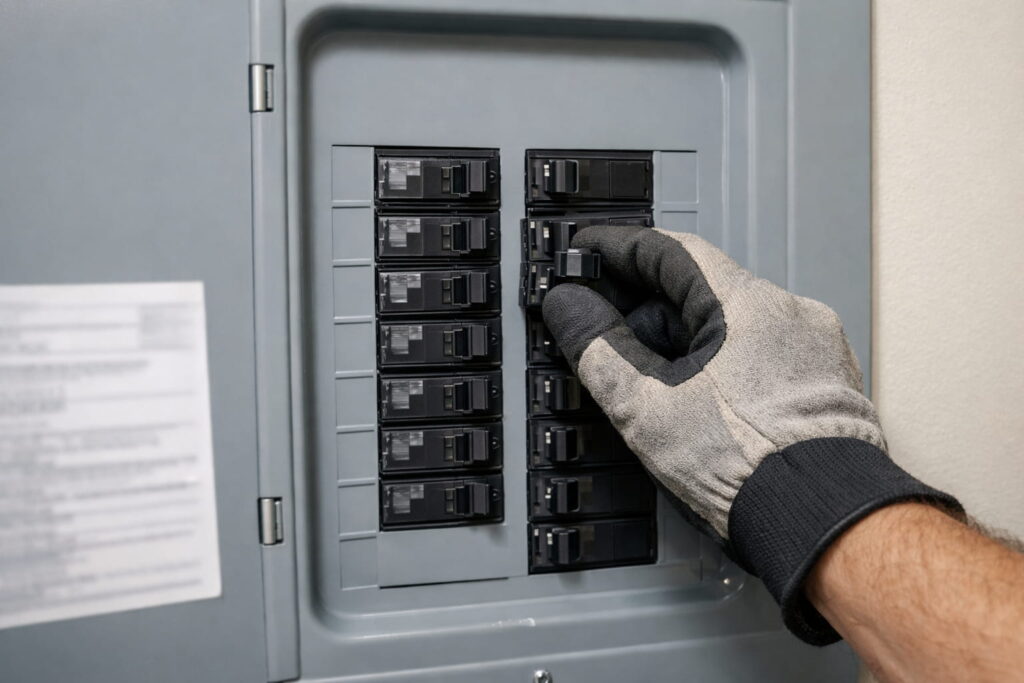
2A) Check the breaker first
- Locate the water heater breaker (often double-pole).
Quick extra check (some homes): there may be a local disconnect switch near the water heater (often a small wall switch or box). Make sure it’s in the ON position before you assume the heater has failed.
- If tripped, flip it fully OFF, then ON.
- Give the tank time to recover, then retest hot water.
For safe “no hot water” checks and reminders to power off before panel access, follow A. O. Smith — What to do if you have no hot water.
When to stop: If the breaker trips again—repeat trips can indicate an electrical fault.
Video (electric tank maintenance + safe checks)
Shows homeowner-safe electric water heater maintenance and inspection steps that often relate to weak/no hot water.
2B) Check the high-limit reset (ECO) safely
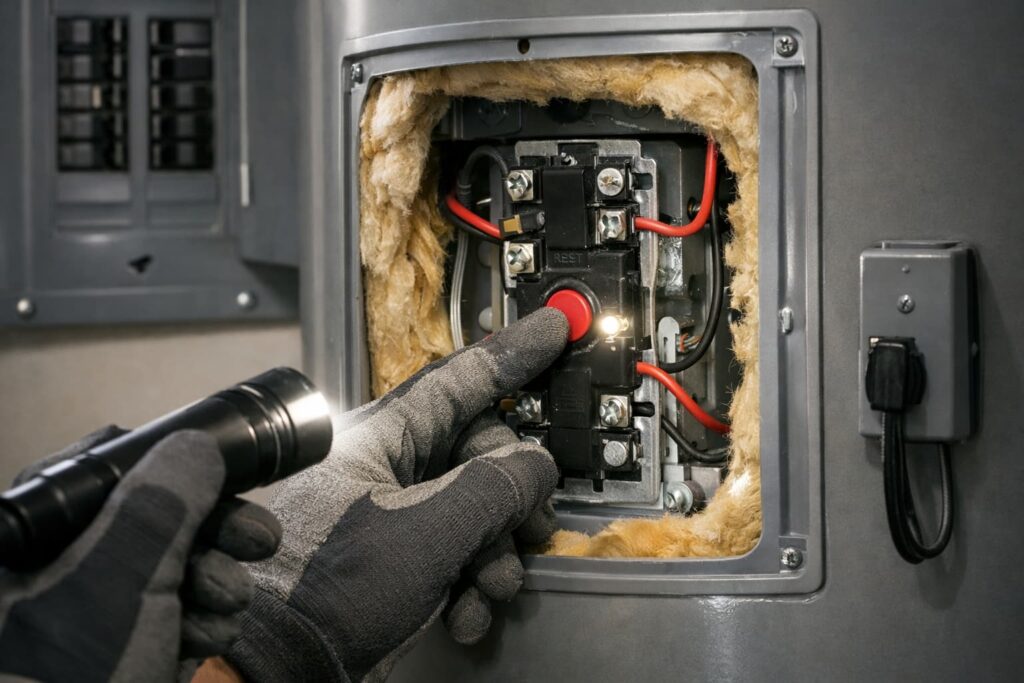
Many electric tanks have a high-limit (ECO) that shuts heating down if overheating is detected.
Safe homeowner steps (general process; follow your model manual):
- Turn the breaker OFF.
- Remove the upper access panel and insulation.
- Press the red RESET button (if present).
- Reinstall insulation and the cover, then restore power.
Rheem documents the reset procedure and also warns that a trip can signal a problem that may need professional diagnosis—especially if it happens again. Rheem — Use & Care Manual (AP23657).
Stop and call a pro if:
- The ECO trips again soon after reset
- You see moisture inside the panel area
- Wiring/insulation looks burned or damaged
2C) Still no hot water? (Set a firm DIY boundary)
If breaker + ECO reset didn’t restore hot water, the next steps often involve component testing (elements/thermostats/wiring). A manufacturer overview of “not heating” troubleshooting pathways is here: A. O. Smith — What To Do When a Water Heater Is Not Heating.
For most homeowners, this is the point to call a licensed electrician or plumber.
Step 3: Gas Tank Water Heater Checks (Safety-Heavy)
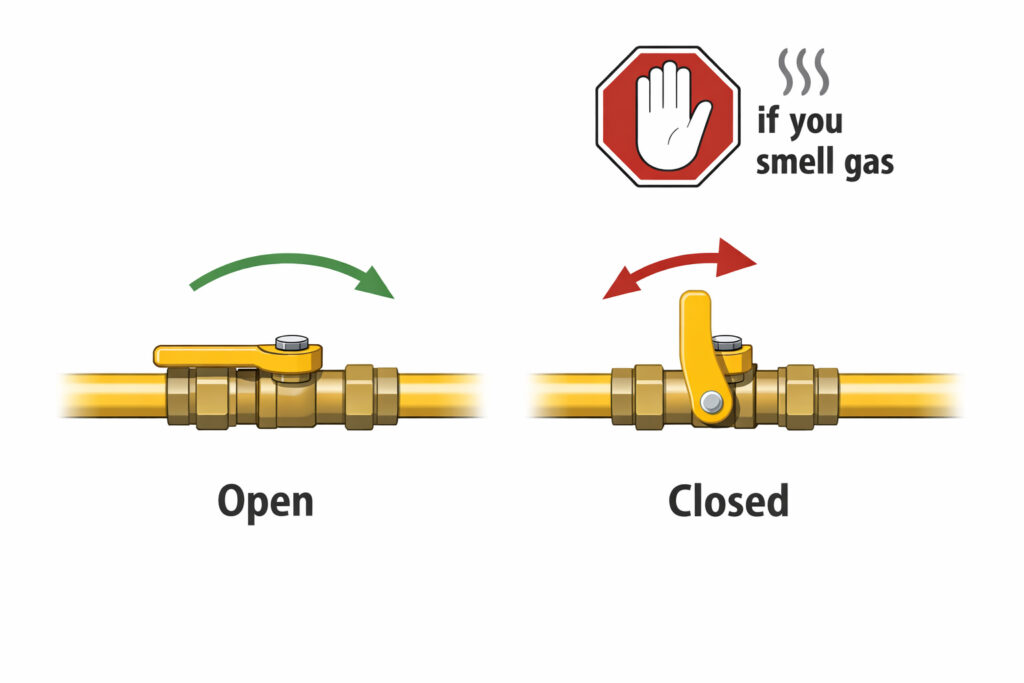
3A) Gas smell = stop
If you smell gas, follow CT.gov guidance (linked above) and do not attempt to relight or troubleshoot.
If there’s no gas smell and you’re still cold: do two safe supply checks before deeper troubleshooting:
- Verify the gas shutoff valve at the heater is fully open (handle parallel to the pipe is typically “open”).
- Check whether other gas appliances (like a stove) are working—if not, the problem may be the home’s gas supply, not the water heater.
If you’re unsure about any valve position, stop and call a licensed plumber.
3B) Check the control/status indicator and follow the manual
Many gas heaters use diagnostic lights/codes. Use your model’s official troubleshooting table to match symptoms to safe next steps.
A representative official manual that includes “no hot water / not enough hot water” troubleshooting is: A. O. Smith — Instruction Manual (PDF).
3C) If a thermal/vent-related safety switch tripped (model-dependent)
Some gas heaters have a thermal switch that can trip (often connected to airflow/overheating/venting conditions). A. O. Smith provides guidance on that concept and resetting in certain cases. A. O. Smith — Reset the Thermal Switch.
Important boundary: if a safety switch is tripping, the underlying cause (air supply/venting/combustion) may be unsafe. This is often a licensed technician call.
Video (gas tank troubleshooting overview)
Gives a structured overview of common gas water heater failure points and helps you decide what’s homeowner-safe vs pro-only.
Step 4: Tankless Water Heater Checks (Flow + Lockouts Matter)
Tankless reminder: a tankless heater only heats when it detects enough water flow. Very low flow (a partly clogged faucet aerator, low-pressure showerhead, or a partially closed valve) can prevent the unit from firing or can cause hot/cold cycling. If tankless is your system, compare flow at multiple fixtures and remove/clean a clogged aerator (fixture-side) if flow is weak.
4A) If you see an error code
- Follow manufacturer reset guidance (often a power cycle) and re-check.
- If the code returns, treat it as a service condition.
Video (find the “why” quickly: error code history)
Shows how to check error code history so you can identify recurring causes of “no hot water.”
Video (common no-hot-water code path: 65/66)
Explains what Error Code 65/66 commonly indicates and what your next safe steps should be.
4B) No error code, but still no hot water
This often points to a flow/activation issue (flow too low or not detected) or a maintenance issue.
Navien notes that “no error code but no hot water” can be related to the flow sensor not operating properly and recommends contacting the installer/service. Navien — Tankless Water Heater FAQs.
Homeowner-safe checks:
- Confirm hot tap is fully open and flow is strong.
- Compare multiple fixtures for flow differences.
- If your manual includes user-cleanable filters/screens, follow the manual—don’t guess.
If the issue is recurring: many tankless manufacturers recommend periodic maintenance (filters/screens and internal descaling/flush procedures) based on water quality. Because steps and intervals vary by brand/model, follow your unit’s manual or have a licensed tech perform the service if you’re not experienced.
Video (maintenance that can restore proper operation)
Shows how to clean the air intake filter (a common maintenance item that can affect performance on some setups).
Step 5: Lukewarm Water or It Runs Out Too Fast
5A) Confirm temperature setting (with scald safety)
If the setting is too low, water can feel lukewarm. If it’s too high, scald risk increases. For official guidance on temperature setting tradeoffs, see U.S. Department of Energy — Lower Water Heating Temperature.
5B) Make sure it’s not simple capacity/recovery
A tank can run out if demand exceeds capacity or recovery time (back-to-back showers, laundry, dishwasher). That’s not always a failure—sometimes it’s sizing or usage timing.
Video (real-world “not enough hot water” diagnosis)
Walks through diagnosing a “lack of hot water” scenario where sizing/recovery and usage patterns matter.
5C) If it changed suddenly, suspect partial failure (pro territory)
- Electric tank: a failed element/thermostat can leave you with some warm water but not enough.
- Gas tank: burner/venting problems can reduce recovery.
Use official troubleshooting flowcharts/tables (see A. O. Smith links above) and call a pro if symptoms persist.
When to Stop and Call a Pro (Non-Negotiables)
Call a licensed pro if:
- You smell gas or suspect a leak
- Breaker trips repeatedly, wiring looks damaged, or panels are wet
- ECO/high-limit or thermal safety devices trip again after reset
- You suspect venting/combustion air issues (gas/tankless)
- The unit has flood/fire/physical damage
- The next step requires live electrical testing or gas control/vent work
Before you call, write down: your heater brand/model, whether it’s tank or tankless, whether you have any error/status codes, and what you already tried (breaker reset, ECO reset, etc.). This helps the technician triage faster and can reduce repeat visits.
FAQs
1) Why is my water heater not producing hot water all of a sudden?
Most sudden causes are a tripped breaker (electric), a tripped high-limit reset (electric), ignition/safety shutdown (gas), or an error/flow issue (tankless).
2) Is it safe to press the reset button on an electric water heater?
It can be safe if you turn power OFF at the breaker first and restore insulation/covers correctly. If it trips again, stop and get it checked.
3) My water heater has power but still no hot water—what does that mean?
On electric tanks, it can indicate a thermostat/element problem that needs testing. On tankless, it can be flow/activation or a lockout condition.
4) Why do I have hot water at one sink but not in the shower?
That usually points to a shower cartridge or mixing/anti-scald valve issue rather than the heater. Test other fixtures to confirm.
5) Tankless water heater has no error code but no hot water—what’s a likely cause?
Often it’s a flow/activation problem (flow too low or not detected). Some manufacturers also point to flow sensor issues and recommend service.
6) What temperature should I set my water heater to?
Many households aim around 120°F for comfort and reduced scald risk, but needs vary. Follow your manufacturer manual and DOE guidance.
7) When should I replace a water heater instead of repairing it?
When a licensed pro confirms a major internal failure or unsafe condition and repair isn’t cost-effective. Avoid replacing based on guesswork alone.
Conclusion
When your water heater not producing hot water becomes a problem, start with safe, high-impact checks: confirm it’s not a single fixture, verify power/controls, and use the correct reset process for your heater type. If you hit repeated trips, gas odor, wet electrical areas, or venting/combustion concerns, stop and call a licensed professional—it’s the safest, fastest route back to reliable hot water.
Sources / References
- Rheem — Use & Care Manual (AP23657)
- Rheem — Residential Electric Use & Care Manual (AP23124-1)
- A. O. Smith — What to do if you have no hot water
- A. O. Smith — What To Do When a Water Heater Is Not Heating
- A. O. Smith — Reset the Thermal Switch
- A. O. Smith — Instruction Manual (PDF)
- U.S. Department of Energy — Lower Water Heating Temperature
- CT.gov — What To Do If You Smell Natural Gas
- Navien — Tankless Water Heater FAQs
- Noritz — Common Tankless Error Codes